




Measures providing legal protection for students and guidelines for schools come into force on January 1
By PETER HANCOCK
Capitol News Illinois
[email protected]
Summary of the story
- Illinois lawmakers responded to President Trump’s crackdown on immigrant communities with new legal protections for students and guidelines for schools that take effect Jan. 1.
- Community colleges will be prohibited from using AI robots to teach courses in place of human professors.
- The Illinois State Board of Education will begin drafting guidelines for the use of AI in K-12 settings.
This summary was written by the reporters and editors who worked on this story.
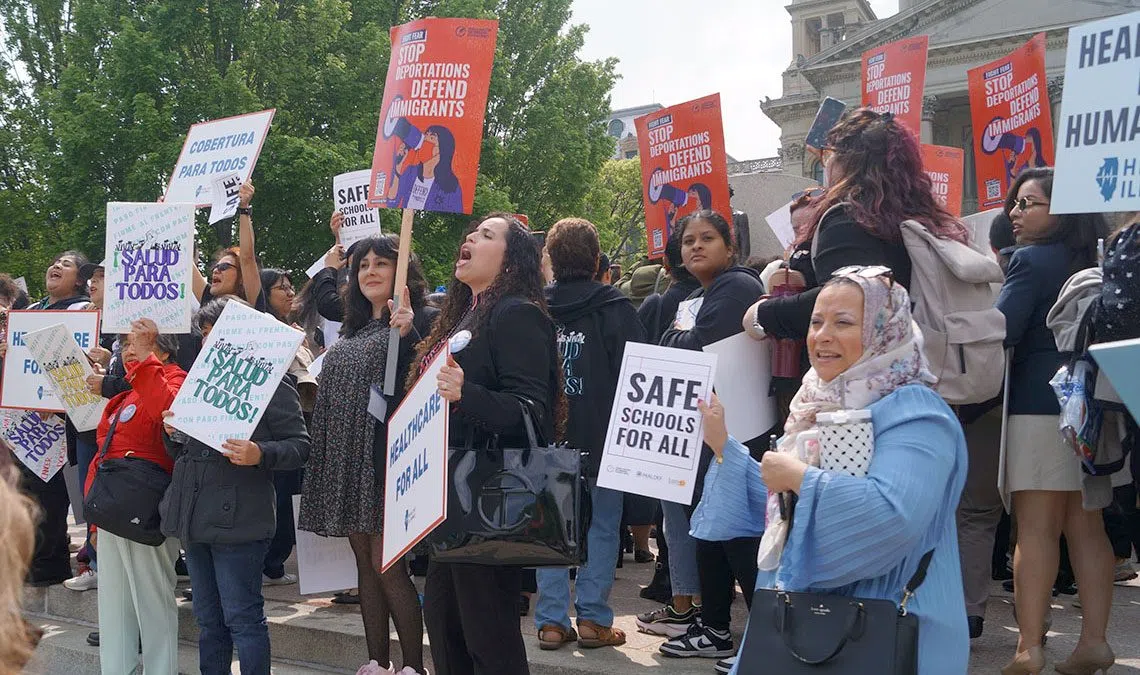
SPRINGFIELD — Immigrant rights and artificial intelligence were two of the hot-button issues influencing public education in 2025. They are also the subject of new education-related laws that will take effect early in the new year.
The rights of non-citizen students, including those not legally present in the United States, became a priority on the education agenda as soon as President Donald Trump was sworn in for his second term in January.
On Trump’s Inauguration Day, the Department of Homeland Security canceled a Biden administration policy that limited immigration enforcement actions in or near “sensitive locations” such as schools, playgrounds, day care centers and school bus stops.
Two days later, Illinois Superintendent of Education Tony Sanders issued what he called “non-regulatory guidance” to local school officials, urging them to adopt policies specifying how and when their staff should cooperate with federal immigration agents by taking enforcement actions or seeking information from school officials.
At the Statehouse, the Democratic-controlled General Assembly also took action, passing bills intended to extend more legal protections to noncitizens living in Illinois.
Participation in school programs
Among these was House Bill 3247which was adopted by the General Assembly in the final days of the spring session in May and was signed into law on August 15. It prohibits schools from excluding or discouraging students from attending school or participating in school programs based on their immigration status or that of their parents or guardians.
“In the face of federal threats to our schools and students, our communities came together and organized to demand that our state leaders stand up for education for all of Illinois’ children,” Lawrence Benito, executive director of the Illinois Coalition for Immigrant and Refugee Rights, said in a statement after the bill’s final approval.
“As the right to a safe and free public education remains under attack from Trump and other state leaders, Illinois has the opportunity to continue defending our values.”
The law specifically prohibits schools from requesting or collecting information from a student or his or her parents or guardians about his or her citizenship or immigration status unless the information is required by state or federal law.
It also prohibits schools from disclosing information about their immigration or citizenship status to any other person or entity, including immigration and law enforcement agencies, unless required to do so by federal law.
Additionally, beginning July 1, schools that violate these bans can be sued in civil court for actual damages.
Scholarships and Immigration Status
Another new law expands the types of state-funded scholarships students can qualify for, regardless of their citizenship or immigration status.
Illinois law already expands eligibility for state-funded student financial aid, such as the Monetary Scholarship Program, or MAP grants, to any student who meets Illinois residency requirements. Parliamentary Bill 460which was signed into law in August, expands that to include programs administered by local units of government.
Artificial intelligence in college
The rapid deployment in recent years of new technologies like ChatGPT, Copilot and Gemeni has raised many new questions for teachers. Should students be allowed to use them instead of reading and writing themselves? And should schools themselves be allowed to use them instead of human instructors to lead classes?
Illinois lawmakers have addressed some of these issues.
Bill of 1859 requires community colleges to ensure that faculty members who teach courses are actual individuals with the necessary qualifications to fill their positions. It also provides that colleges cannot, in place of a faculty member, use AI programs “as the sole source of instruction.” It does, however, allow faculty members to use AI as a teaching tool in their classrooms.
“Artificial intelligence is a powerful tool that can improve the ability of students and teachers to learn and teach, but it cannot replace an instructor,” Rep. Abdelnasser Rashid, D-Bridgeview, the bill’s lead sponsor in the House, said in a statement. “This legislation clarifies that college courses must be taught by real people, not AI.”
AI in primary and secondary schools
Lawmakers have been less specific about how AI should be managed at the primary and secondary education levels. Instead, they asked the Illinois State Board of Education to develop general guidelines.
Senate Bill 1920 directs ISBE to develop statewide guidance for districts and educators on the use of AI in K-12 settings. This includes a basic explanation of what AI is and how it works, as well as descriptions of how it can be used in the classroom “to inform teaching and learning practices while preserving the human connections essential to effective teaching and learning.”
The law also directs ISBE to include guidance on the impact AI systems and applications could have on student data privacy, best practices for teaching students about responsible and ethical uses of AI, and the dangers of “unintended and disparate biases against particular populations inherent in artificial intelligence products.”
The law directs the ISBE to publish these guidelines by July 1.
Other education laws
Also starting Jan. 1, seventh and eighth graders will be able to quickly earn high school credits.
House Bill 3039 authorizes districts to award credit to seventh- and eighth-grade students who enroll in high school classes provided that they successfully complete both the course and the end-of-course examination demonstrating that they have attained high school level.
Parliamentary Bill 1366 requires districts to inform parents or guardians of students with special needs that they have the right to bring a third-party advocate with them to meetings regarding their student’s individual education plan or to IEP meetings.
Capitol News Illinois is a nonpartisan, nonprofit news service that distributes coverage of state government to hundreds of media outlets across the state. It is funded primarily by the Illinois Press Foundation and the Robert R. McCormick Foundation.