




Right now, it would seem safe to say that AI assistants are here to stay. Sure, they have their quirks, but they can provide a substantial productivity boost for certain tasks. What is less certain is how we will use these tools in the future. Web interfaces don’t capture the full potential of these assistants, with copy-pasting text and clicking through browser tabs creating unnecessary digital friction. Maybe voice assistants will eventually prevail, but they don’t have a particularly strong position yet.
A group of MIT researchers think the ideal interface might be what they call AI Cohabitants. To test this theory, they developed an AI cohabitant they call the Stochastic parrot. It is a robot parrot that is permanently installed in its user’s home. There, it uses AI to observe and learn from its user by looking for patterns. What the stochastic parrot learns allows it to subtly participate in its owner’s daily routine.
Let me slip into something more comfortable… (📷: E. Chang et al.)
Unlike traditional AI assistants that are called into action on demand, AI cohabitants are designed to function more like roommates or pets. They are always present, inherently physical, and capable of acting autonomously without explicit prompts from the user. The goal is to reverse the familiar subservient dynamic of modern AI, replacing it with a relationship built around character, independence, and continued co-presence rather than constant command-and-response interactions.
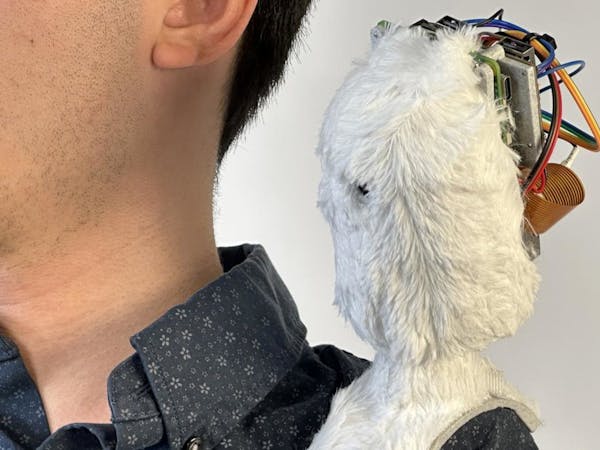
Physically, the Stochastic Parrot is a small, non-humanoid robot with fuzzy textures, a stylized bird-like silhouette, and limited but expressive movement driven by two servos. It can sit on a desk or perch on a user’s shoulder, reinforcing the idea that it shares space with its owner rather than existing behind a screen. Equipped with a camera, microphone and speaker, the parrot can see, hear and speak, allowing it to interact with its environment in context.
On the software side, the parrot is powered by a real-time conversational AI model guided by a system prompt that defines its personality, tone and story. Rather than seeking deep emotional empathy or human imitation, the parrot adopts a motivating, rational personality that sometimes refuses requests or pushes them away when interactions seem unproductive. This non-sycophantic behavior is intentional, as researchers believe that slight unpredictability and setting boundaries help establish a sense of agency and authenticity.
Another view of the robot (📷: Q. Kuang)
Preliminary user testing with seven participants showed early signs of emotional engagement and social acceptance. Participants often treated the parrot in the same way as a real pet, talking to it casually, petting it, or introducing it to new environments. In some cases, the parrot’s humorous or slightly provocative responses surprised users and helped solidify its character.
Although the researchers are careful to note that AI cohabitants are not suited for deep emotional support or therapeutic use, they see strong potential in areas such as motivation, habit formation, and contextual reminders. By making AI an independent character that lives alongside humans, rather than a tool that simply reacts to commands, the stochastic parrot could make AI less transactional and more experiential.