





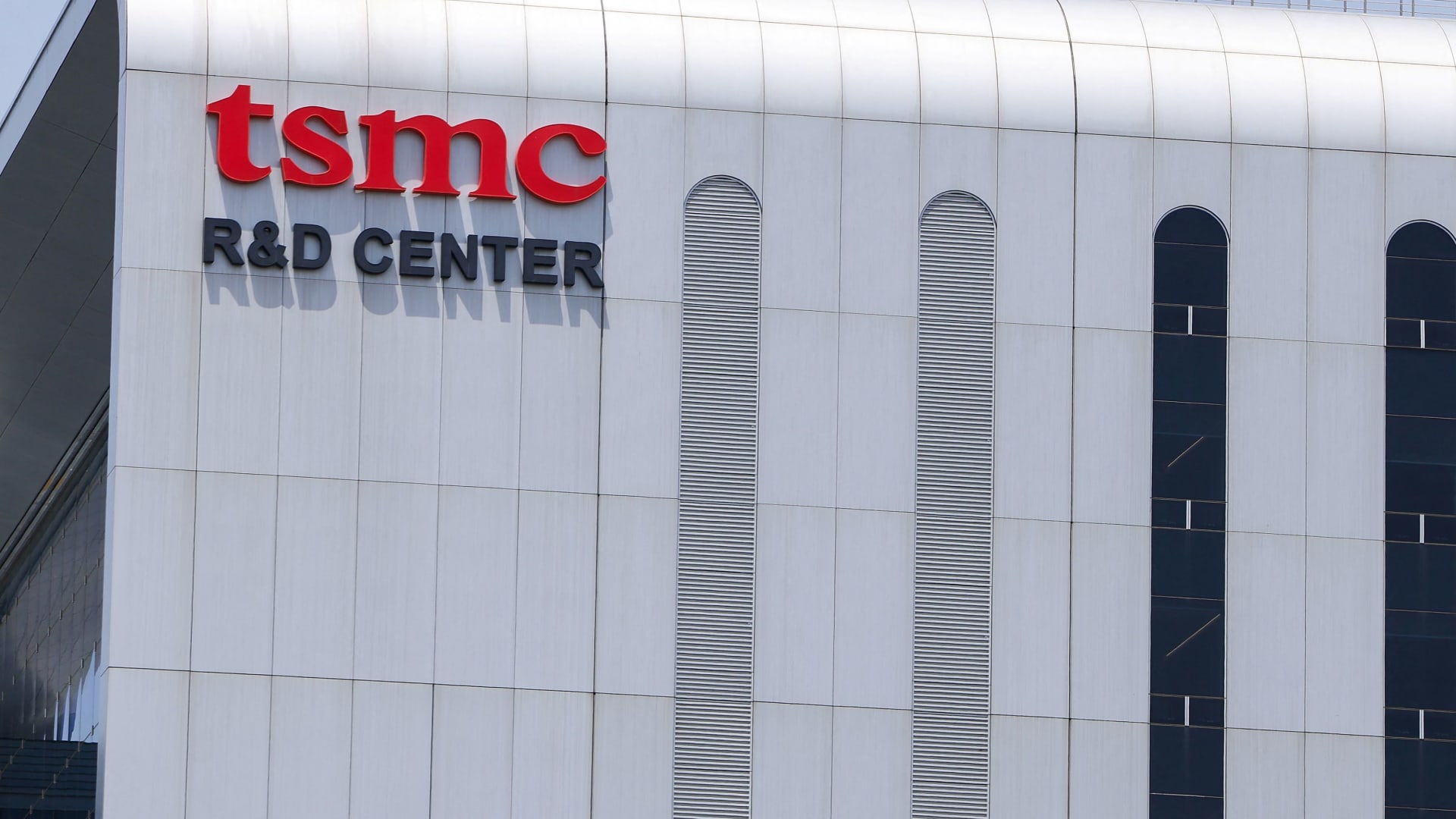
A view of the TSMC Global R&D center in Hsinchu, Taiwan on April 15, 2025.
Ann Wang | Reuters
Thursday offered markets a rare respite from the incessant geopolitical upheavals. Yet the week’s headlines still reflect broader global dynamics.
Case in point: Taiwan’s $250 billion investment in chip production in the United States, which is as much a strategic as a commercial decision. The deal will see the US lower tariffs on Taiwanese imports from 20% to 15% and remove them completely on other products, such as generic pharmaceuticals and aircraft components.
Taiwan Semiconductor Manufacturing Co. has already purchased land and could expand into Arizona as part of the deal, Commerce Secretary Howard Lutnick told CNBC’s Brian Sullivan in an interview Thursday. The company is also considering additional investments in the United States beyond current plans, TSMC Chief Financial Officer Wendell Huang told CNBC’s Emily Tan on Thursday.
The world’s largest contract chipmaker also reported stellar results on Thursday. TSMC also said it was increasing its planned capital spending for 2026, indicating that demand for artificial intelligence remains high this year.
This wave of optimism helped propel stock markets higher. Semiconductor and AI-related stocks such as Nvidia, Advanced microdevices And Applied materials progressed in the United States, while European producers of chipmaking equipment, such as ASML And ASM Internationalalso climbed.
In Europe, stocks are expected to end the week at a record high. Rising tech stocks have propelled the sector to levels not seen since 2000, while new data showing the German economy will grow in 2025 for the first time in two years also boosted confidence.
Oil prices, meanwhile, fell after U.S. President Donald Trump said he might pause any attacks on Iran, easing a major source of near-term risk.
But tensions remain elsewhere. Several NATO countries have announced that they have deployed troops to Greenland as part of a joint exercise aimed at strengthening security in the Arctic. The moves follow tense transatlantic discussions over US proposals to acquire the semi-autonomous Danish territory – a suggestion that has destabilized European partners and raised fundamental questions about the alliance.
— CNBC’s Kif Leswing and Leonie Kidd contributed to this report.
What you need to know today
US gets 30% higher Venezuelan oil prices. Washington has finalized its first sale of Venezuelan oil worth about $500 million, which represents “about a million dollars.” Realized price 30% higher when we sell the same barrel of oil as [Venezuela] sold the same barrel of oil three weeks ago, US Energy Secretary Chris Wright said Thursday.
Indian exports to China soared in December. Shipments increased 67% year-over-year to $2 billion. In contrast, exports to the US fell 1.8% to $6.8 billion due to 50% tariffs on New Delhi – but the US remains India’s largest export market.
Mitsubishi to acquire US shale gas assets The Japanese conglomerate will acquire shale gas assets in Texas and Louisiana from Aethon Energy Management for $7.53 billion. Actions of Mitsubishi Companyn trading down 1.3% as of 2:20 p.m. in Singapore (1:20 a.m. ET).
American indices rebound after their losses. Major US indexes rose on Thursday, supported by gains in chip and bank stocks, as Goldman Sachs and Morgan Stanley beat estimates. Markets in the Asia-Pacific region were mixed on Friday, even as chip stocks rose overall.
[PRO] Income investors should be diversified: UBS. Markets will likely be much more volatile this year than in 2025, the Swiss bank said. UBS analysts recommend splitting allocations across these assets.
And finally…
Oil markets are pulled in all directions. Here’s how market observers get it
Energy markets have been rocked by volatility in recent days as investors weigh the violent crackdown on civil unrest in oil-rich Iran and Washington’s response.
However, Ed Bell, acting chief economist and research group head at Emirates NBD, one of the UAE’s largest lenders, told CNBC’s “Access Middle East” on Thursday that while markets were watching the situation closely, little had actually changed.
— Chloe Taylor and Sam Meredith