


For many supply chain organizations, the resilience conversation has shifted from reacting to disruption to understanding exposure. This shift requires companies to dig deeper, beyond tier-one suppliers, beyond transactional data, and into the physical and geographic realities that shape how goods are purchased, moved and stored over time.
The question is no longer whether organizations have data, but whether they understand where that data comes from and how it is connected across their supply chains.
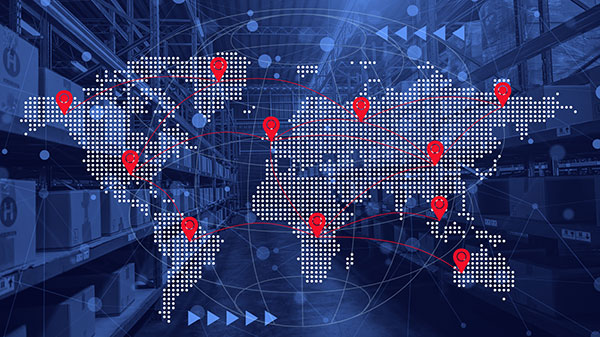
This growing focus on source-level and location-based intelligence is reshaping how businesses think about advanced analytics and AI. Before algorithms can meaningfully predict risks, optimize networks, or simulate future scenarios, organizations must first create accurate, living, and spatially connected databases. As Cindy Elliott, who leads Esri’s industry teams, sees it, resilience and AI readiness are earned upstream by basing decisions on real-world conditions, gaining visibility into supplier ecosystems and an integrated view of the physical supply chain.
“If you don’t actually get the correct source and original data, as well as the data from the live feed, the AI is not going to produce what you want. [expect]” Elliott told Supply Chain Management Review at the recent NRF Retail Big Show in New York.
Esri offers geographic information system (GIS), location intelligence and mapping software. Its software is used by organizations seeking to maximize sustainable and resilient supply chains.
Resilience starts at the source
One of the most visible areas where this data gap appears is in responsible and resilient sourcing. Elliott highlighted the growing number of consumer brands that are working to understand not only who their suppliers are, but also where raw materials come from and under what environmental and social conditions.
Using the example of coffee, Elliott described how Nestlé has worked to build resilience in a supply chain that it does not directly own. “They don’t own the coffee farms. In fact, they often don’t even own the distribution to get the raw material to the roaster,” she said. Yet Nestlé recognized that climate stress was reducing land suitable for coffee production.
By working closely with farming communities and tracking the environmental conditions of more than 100,000 coffee farmers, Nestlé was able to identify areas where land is under pressure and how to help these environments recover. “They needed to strengthen their coffee supply chain for decades to come,” Elliott said.
The result is a data foundation that now supports more advanced modeling. “Imagine they have all these years of data and data and agricultural conditions,” she said. “Now they can run models; where are the next 10 years going for coffee? Will the environment or land be more applicable to coffee growing than it is today?”
The Level Three Visibility Challenge
This type of information remains difficult to obtain for many organizations, as supplier visibility often fades beyond level two. “As it moves from level one, level two, level three, level four, level five, a lot of manufacturers and retailers could move to level two,” Elliott explained. “But it gets blurry at level three; it’s all about brokers and other influencers.”
Historically, this opacity was tolerated, but this is changing. “There was no scrutiny, there was no reporting requirement and there was no brand risk,” Elliott said. “We didn’t care as long as the bean appeared.”
That has changed. Environmental reporting requirements, reputational risk and, above all, resilience concerns are pushing companies to get closer to the origin of raw materials. “We need to safeguard or secure our supply network for five and 10 years,” Elliott said.
From sourcing to network optimization
Beyond raw materials, the same data-driven logic applies to network and asset optimization. Elliott highlighted the work Esri has done with companies like Cisco and Chick-fil-A, focusing on how physical assets (stores, distribution centers, fleets and service networks) interact as a system.
“It’s about where do I operate globally? What is my real estate? What is my store footprint? What is my distribution footprint? ” she says. The goal is not isolated optimization, but system-wide visibility that takes into account demographics, traffic, population shifts and service level requirements.
When these elements are connected spatially, organizations can see vulnerabilities propagate across the network. “They create these graphical databases that allow them to detect a pressure or a vulnerability at any given moment and understand how it relates to a disruption,” Elliott explained.
This connected view becomes the basis of a digital twin, which reflects the actual state of the supply chain rather than static assumptions. “You now have a digital twin of your entire procurement operations,” she said. “We don’t tell people there’s a typhoon. The system tells you what the impact is.”
Breaking down silos
The move toward resilient, data-driven networks also requires breaking down long-standing organizational silos. “Real estate was in a silo. Their operational data was in a silo. Their built environment was in a silo,” Elliott said, describing what she saw at large global companies.
What’s changing, she added, is the influence of the supply chain. “Supply chain [now has] such a seat at the table today as it was five years ago” that instead of real estate teams planning expansion first and closing the supply chain later, companies are starting to collaboratively design growth strategies.
“Location is a common chain that connects everything,” Elliott said.
AI readiness is earned, not installed
The takeaway for supply chain leaders is clear: the value of AI comes not from installing tools, but from preparing through disciplined data work.
“It’s a great example of investing and leveraging building the foundation to get big gains on the back end,” Elliott said.
As organizations look to scale AI beyond pilot projects in 2026, the winners will not be those with the most advanced algorithms, but those who understand their networks spatially, operationally, and systemically well enough to put AI to work where it matters most.