


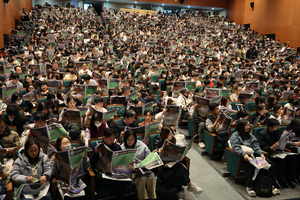
Anxiety over AI-driven employment disruptions is growing. But until new paths to success become clearer, many will stick to the beaten path: elite colleges, coveted bachelor’s degrees.
Bae Hyun-jin (pseudonym), 46, is an activist openly opposed to the culture of private education in South Korea.
However, she carries a secret.
She currently spends about 2 million won ($1,380) a month on tutoring for her high school-aged son, hoping, like most Korean parents, that he will be able to get into an elite university.
His expenses account for more than half of South Korea’s average monthly salary of 3.73 million won.
While publicly criticizing a society “disgusted by private education”, Bae finds herself trapped in a dilemma: in a country where the university a person attends still largely determines their chances in life, she feels unable to remove her child from the frantic race to study.
Recently, another layer of anxiety has been added.
Although she is quietly investing in private education, Bae says she cannot ignore the constant flow of information warning that artificial intelligence will replace white-collar workers.
Her anxiety has increased, but she says there’s not much she can do. The reduction in tutoring is not even considered.
“They say AI is reshaping recruiting, but honestly, I don’t know,” she said. “Even if AI replaces jobs in the future, I can’t tell my child to stop preparing for it and start preparing for something else.”
“With things like coding, where the replacement is already visible, I can at least say, ‘This is not the right path,'” she said. “But for other professional fields, the changes are not yet tangible, so I don’t know what to do.”
Anxious parents, uncertain students
A clear formula for success has long dominated in Korea: intense study for the largely multiple-choice college entrance exam, followed by entry into a prestigious university. This then opens the door to employment in a conglomerate or joining a well-paid white-collar profession, such as a doctor, lawyer or accountant.
In a way, parents say, it was simpler before. You might end up paying millions of won in cramming schools, but there was a reliable path to follow and a clear goal to aim for.
But as the AI era begins to take shape, even at an early stage, many parents and students find themselves confused.
In 2023, the Bank of Korea warned that high-income professions such as medicine, law and accounting were highly vulnerable to AI disruption. Bill Gates and Elon Musk have also said that AI could soon replace doctors and lawyers.
A survey of 1,225 employers and an analysis of about 3 million job postings by Randstad, the world’s largest recruiting services company, showed this month that about 38% of employers plan to hire fewer workers this year than last year because of AI.
For Koreans who have spent years focusing on elite universities and professional careers, such headlines only amplify anxiety without offering concrete alternatives.
Ryu Eun-hye, 47, mother of a daughter in her first year of high school, spends 1.5 million won a month on private education and plans to increase that amount when her daughter enters second year.
“I’m anxious. My daughter is anxious. We’re both anxious,” she said.
“For those who study well and have set goals, it seems good. But for ordinary students like my daughter, I don’t know what to tell her,” Ryu said.
“A few years ago, people said that learning to code was the key to preparing for the future. Now that has been replaced (by AI) first,” she said. “The problem is that no one knows what will be replaced next.”
She said if AI had already replaced everything, it would be much easier to choose. But now that is no longer the case. So she can’t be the only parent to abandon private education.
“Perhaps children who fully grow up in the AI era will educate their own children differently,” Ryu said. “But for parents like us, who grew up thinking that “SKY” universities, elite professions, and big companies define success, it’s not easy to prepare our children for a completely different path.”
“SKY” refers to the three best universities in South Korea: Seoul National, Korea and Yonsei.
Lee Byung-hoon, honorary professor of sociology at Chung-Ang University, says anxiety among students and parents is real and growing.
“The threat that AI poses to jobs is fundamentally different from past disruptions,” he said. “The speed of change is frightening. When artificial general intelligence emerges, it will raise the question of whether human work itself can be sustained.”
“Parents and students investing in education today may increasingly fear that no level of education can protect them from AI,” he said.
He predicted that the obsession with going to college no matter what might change in the future, albeit slowly.
“If a degree no longer guarantees a job or reward, some might conclude that it is better to enter skilled trades or service sectors that AI cannot replace.”
Career paths still considered a “guaranteed” path to success
In the meantime, many students and parents remain focused on their immediate goals.
Lee, a 21-year-old student preparing to retake the college entrance exam, said the idea of AI replacing professionals does not seem to have taken hold yet.
“People say professionals will be replaced, but the best students still want medical or law school,” she said. “Korea still values academic background. From a student perspective, AI disruption is not a priority,” she said.
She added that many applicants continue to “lower their major” to gain admission to higher-ranked universities, referring to the practice of choosing less competitive fields to improve their chances of being accepted.
“Maybe it’s because we haven’t experienced it ourselves.”
Another 21-year-old college applicant named Choi, who is also preparing to retake the entrance exam in hopes of majoring in artificial intelligence, said the uncertainty itself was unsettling.
“The idea that AI could replace professional jobs seems anxiety-inducing,” she said. “Technology is advancing so quickly that the structure of jobs could change dramatically. »
“But the belief that the academic path and professional career guarantee stability and social confidence remains strong. This is why entrance exams and professional competition will remain intense.”
The mother of a high school student who wished to remain anonymous was a firm believer in academic pedigree – even in the age of AI.
“Even if AI imitates humans, I don’t think it can completely replace them,” she said. “The money stays with those who already have it. Inequalities will worsen. The ladder to cross the classes is study.”
“Academic pedigree is the only thing that lasts. It has been that way for centuries and cannot be changed. Academic degrees provide a sense of comfort.”
Education professor Yang Jung-ho of Sungkyunkwan University said private spending on education is unlikely to decline at the moment.
“As long as Korea’s admissions system remains unchanged, private education will continue,” he said.
“People talk about replacing doctors, but as long as these effects are not felt directly, it is difficult to react in a concrete way. There is a lot of talk, but little visible change.”
“From a student’s perspective, getting into a good university always provides the greatest advantage when choosing a career, which makes AI disruptions harder to feel.”
Many young people currently preparing for a professional career continue to view it as the last viable path.
A CPA exam candidate shared a similar view: “I’m not very convinced yet. The use of AI will increase, but 100% replacement is impossible. Experts are still needed to use AI.”
A second-year Yonsei University student majoring in food and nutrition is preparing for a college transfer exam to move into veterinary medicine. She believes that the work of a dietitian can be replaced by AI, but not that of veterinarians.
“In professions that deal directly with life, such as doctors, it is not clear who is responsible for AI errors,” she explained.