




(TNS) — For many residents, stinking trash is a nuisance that must be disposed of as quickly as possible, often without concern for what happens once it’s thrown into a trash can.
This waste has to go somewhere, usually to a landfill. But the landfill used by South Hampton Roads municipalities fills up quickly, requiring a long-term solution and an alternative way of disposing of waste.
Commonwealth Sortation, a Colorado-based subsidiary of AMP, was tapped to provide it. In November, it was got a contract from the Southeastern Public Service Authority to process a large portion of the region’s waste and recycling materials over the next 25 years.
AMP touts the use of artificial intelligence to help improve recycling efforts and reuse waste. Here’s a look at how the Portsmouth processing and sorting facility works.
LESS GOES TO LANDFILL
SPSA and AMP officials say the partnership will divert waste from the Suffolk Regional Landfill and expand its capacity to 2095 instead of 2060. An estimated waste diversion rate of 50 percent and a recycling rate of at least 20 percent are expected, which is up from the current recycling rate of about 7 percent. SPSA processes approximately 460,000 tons of waste per year for Chesapeake, Norfolk, Portsmouth and Suffolk. and Virginia Beach, in addition to surrounding communities such as Franklin and Southampton counties and the Isle of Wight. For decades, the WIN Waste Plant, formerly known as the Wheelabrator Facility, burned 80 percent of the region’s waste and converted it into steam power for the Norfolk Naval Shipyard. But that completed in 2024 after the Navy announced plans to build its own natural gas plant to supply the shipyard.
AMP’s operations, located at Recycling & Disposal Solutions of Virginia in Portsmouth for at least a year as part of a pilot program, tout the use of artificial intelligence to help improve recycling efforts and reuse waste. Operations will span two sites, with around 120 workers processing around 540,000 tonnes of waste each year. This includes workers who deliver, sort and process waste as well as engineers who manage software and equipment.
AMP officials expect the facility to be located at 3325 Frederick Blvd. will be fully operational by the end of the month, and all waste volumes will be processed by April. And within a year and a half, AMP officials plan to operate another facility on Victory Boulevard — the site of the former Wheelabrator — where about 100 employees will convert and transport some organic waste into charcoal-like products that can be sold commercially.
THE PAGENT PROCESS
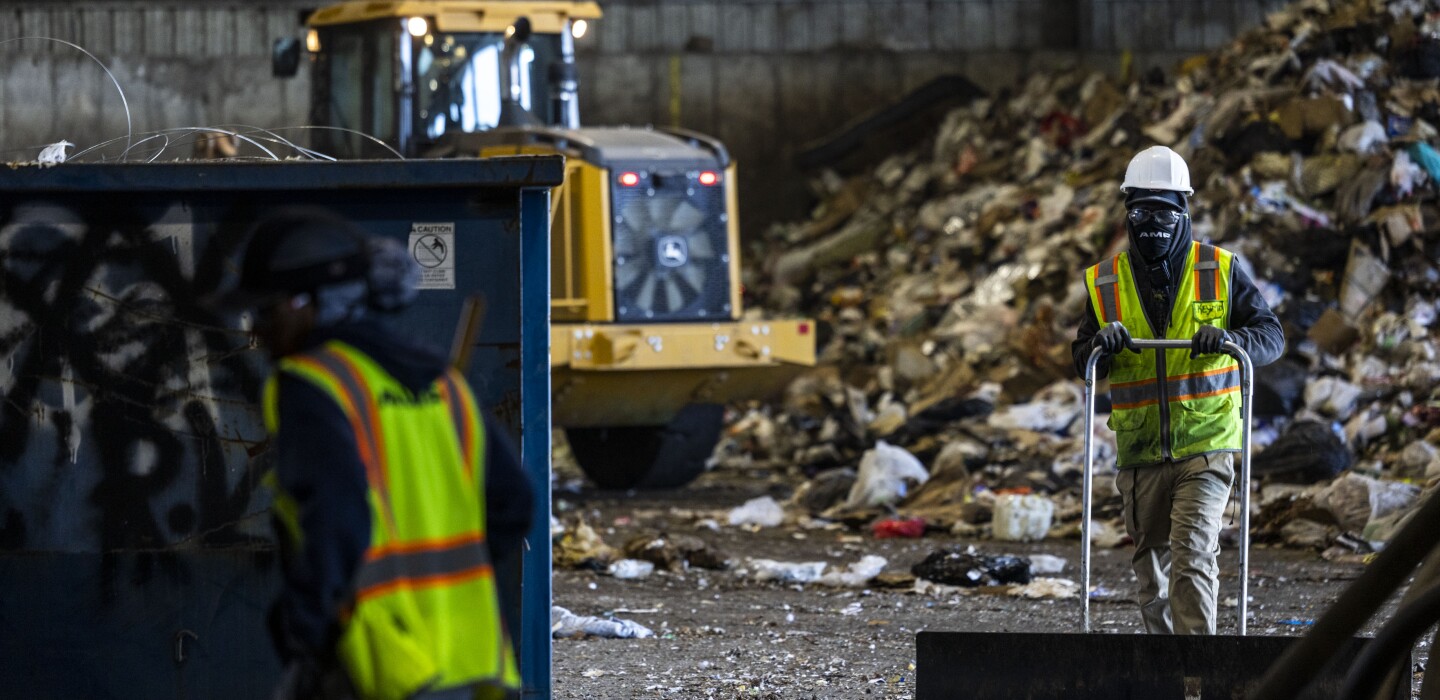
AMP’s equipment and technology remove and sort recyclables from mixed waste streams and reuse organic waste. The use of technology aims to improve efficiency by minimizing the labor required, but waste care still involves some frontline workers armed with protective gear braving the omnipresent stench. The process is noisy, so headsets are required for communication.
Over-the-road trucks collect waste from participating cities in South Hampton Roads, bring it to the Frederick Boulevard site and dump the mixed waste stream onto a concrete floor. A dump truck equipped with a plow then pushes the waste into separate, manageable piles before dumping them one by one into a large basin.
From there, the waste goes up an electronic scale and is placed in a shredder to reduce the size of the items and minimize their bulk. The ideal maximum size is about the size of a pizza box. Two people on the line then begin sorting, removing stringy items and large items that cannot be handled by the equipment.
The waste then moves through a long orange tube-like structure that helps sort it by size, with particles smaller than a few centimeters falling through cracks on one belt and larger pieces taking another route.
Then, equipment inside a doghouse-like structure uses AI to identify, sort and further separate waste types, such as plastic, paper, cardboard and organic waste, sending them through different conveyor belts.
The recyclable products will ultimately be compacted into “bales” which can be purchased.
Although the smell of waste permeates the outdoor facility and leaves its mark at every step of the process, perhaps the most pungent area of the line is the organic stream, nicknamed the “brown” stream because it often includes leaves and food scraps. The organic waste will ultimately be transferred to the Victory Boulevard facility to be heated and converted into biochar, a product similar to charcoal that can be sold commercially for use in concrete and other industrial materials.
“All that organic matter that would decompose in a landfill and create methane, which is a pretty potent greenhouse gas, is sort of captured and trapped in the biochar, and it stays there instead of being released into the atmosphere,” said Andrew Trump, AMP’s vice president of commercial.
But until that facility is fully operational, organic waste will be compacted on-site at the Frederick Boulevard facility into a soil mixture and then transferred to the landfill to be used as a “cover” overnight. That site currently measures about 105,000 square feet, but the goal is to add another 45,000 square feet for operations, according to AMP.
INVESTMENT
AMP officials say the deal represents a $200 million investment in capital, equipment and about 120 jobs. AMP CEO Tim Stuart said recruiting is underway at the Frederick Boulevard location.
“So that allows their landfill to extend their life, double their age, which gives a lot of certainty to that area from a disposal standpoint, and certainly creates an economic benefit because you’re in control of what’s happening,” Stuart said. “And then all the environmental impacts of biochar, of fewer trucks on the roads, of just the movement of materials – all of that has a significant impact on the environment.
“So it’s really a win-win situation on all levels: for residents, for commercial businesses, for the environment.”
©2026 The Virginian Pilot. Visit pilotonline.com. Distributed by Tribune Content Agency, LLC.