



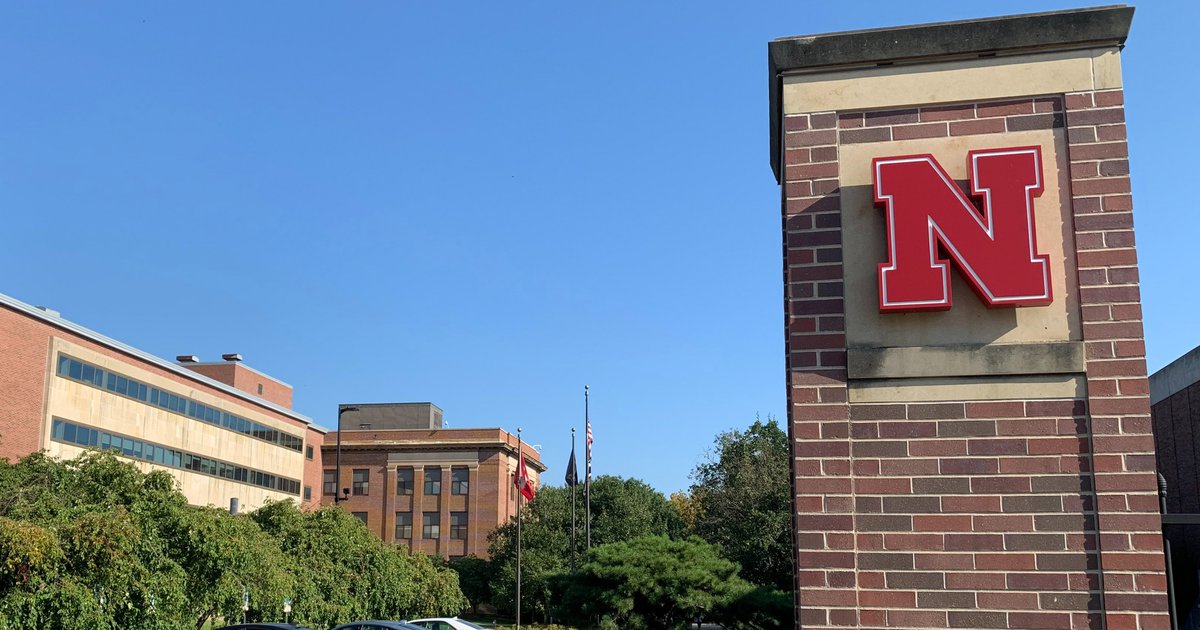
The University of Nebraska announced Monday that a new company will rely on artificial intelligence. NU President Jeffrey Gold wrote in a university-wide email that the new “University of Nebraska AI Institute” will aim to expand the use and research of AI in multiple areas, including health care, agriculture, rural and urban development, business and national security.
Gold said the new systemwide AI institute “will position Nebraska as a national leader in shaping the future of responsible, human-centered artificial intelligence.”
NU’s announcement says the institute will be structured as a “hub-and-spoke model” that will coordinate AI research, education and engagement efforts across the university system “while leveraging the unique strengths of each campus and its faculty and positioning our university as a leading institution in this space.”
The AI Institute will be co-led by UNL faculty members Santosh Pitla, professor of biological systems engineering, and Adrian Wisnicki, professor of English. The creation of the program resulted from a recommendation of the NU AI Task Force, a faculty-led group that developed a system-wide discussion and plan for how the university uses artificial intelligence in its research, outreach, service and teaching.
In the task force report, faculty members said the university system must develop an institute with specialized centers on campus. The report’s recommendations state that the institute’s key responsibilities should include a three-, five-, and ten-year strategic vision for AI research, promote “fundamental” AI research, evaluate and implement “strategic cluster hires” to build AI knowledge across the Institute, lead efforts to secure external investment and partnerships with industry leaders like OpenAI, Google, Microsoft, and AWS, oversee AI ethics policies, and facilitate the “cross-campus” collaboration.
The task force also recommended that each University of Nebraska campus host one or more specialized AI centers based on its strengths and resources, but “certain cross-cutting areas of AI expertise” that require faculty collaboration across campuses will be hosted “at the institute level.”
The task force created several “key initiatives” for its major campuses. The University of Nebraska Medical Center will focus on AI in healthcare, with priorities focused on AI-driven healthcare innovation, the integration of AI tools for clinical decision support, and the ethics of AI in healthcare applications.
UNL will have a focus on AI in agriculture with initiatives focused on fostering partnerships with agricultural industries, developing AI tools for rural and agricultural optimization, and hiring and training AI staff and students for agricultural technology.
The UN will house the Center for AI, Urban Innovation and Business, focused on developing “smart urban infrastructure solutions,” strengthening cybersecurity research, expanding the use of AI in business and legal applications, and training professionals in AI ethics.
UNK will focus on AI in workforce and rural development, with strategies to deliver specialized AI development, develop AI tools to improve education provision, and facilitate commercialization of technologies for rural businesses.
In addition to the major colleges, the working group recommended the creation of two new “transversal” centers. One of these would be an “AI Center for the Humanities, Arts and Ethics” that would focus on AI research and applications in the fine arts and humanities. The other would be an “AI Center for National and Homeland Security” that would focus on AI research and applications in national security, cybersecurity, threat detection, defense systems and emergency response, according to the task force’s recommendations.
The AI Institute would seek federal grants to support much of its basic and applied AI research, as well as create public-private partnerships with “industry leaders” to expand innovation and commercialization. The strategic plan also calls for the institute to collaborate with Nebraska policymakers to “ensure AI research supports the state’s economic priorities.”
This announcement follows a tumultuous year for NU. The system faced steep cuts from the Nebraska Legislature in 2025. Two of its colleges, UNL and UNK, subsequently cut millions of dollars from their budgets. UNL faced the deepest budget cuts as leaders closed four academic programs. The college’s chancellor recently and abruptly resigned in January after months of scrutiny.