



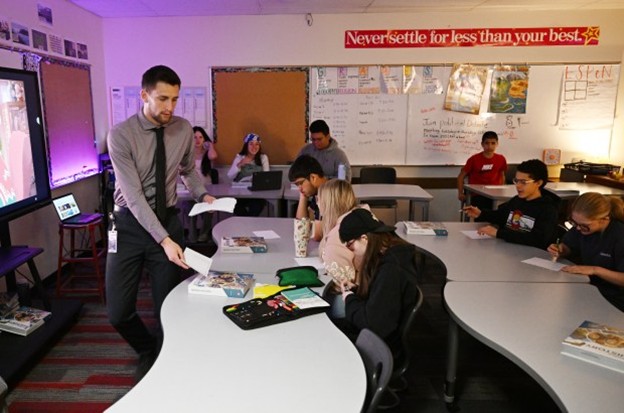
Teacher Adam Gravenor distributes lesson cards he created with the help of AI technology to accompany the class textbook at Coronado High School in Colorado Springs on November 17, 2025. (Photo by RJ Sangosti/The Denver Post)
COLORADO SPRINGS — As Adam Gravenor’s world history class settled into their seats one November day, he handed out worksheets containing questions about social class changes that occurred in the mid-to-late 1800s.
Turn your textbooks to page 571, Gravenor told his students at Coronado High School in Colorado Springs.
The students, with just their textbooks and pencils, began answering questions about how industrialization and colonization changed society, from literature to the role of women.
Not a single student used a computer while the teens wrote their answers that morning, yet their worksheet was created with artificial intelligence.
THE rise of AI in education has sparked fears that students will cheat and not develop critical thinking skills. But K-12 teachers like Gravenor are also turning to technology to write lesson plans, track student progress and create assignments.
“AI has redefined the way we think about the classroom,” Gravenor said.
THE Colorado Springs School District 11who runs Coronado High, tested AI with a small group of teachers two years ago. Today, about 100 of the district’s approximately 1,800 teachers use AI to create lesson plans, classroom activities and other academic content.
Gravenor can use AI to write lesson plans based on the classroom curriculum and state academic standards, which he says helps make the teacher and their students more present in the classroom.
The teacher now leads discussions that teach students certain topics as well as interpersonal and other skills, instead of just having students complete worksheets on their laptops. This helped students ditch their laptops and focus on their textbooks, Gravenor said.
Teenagers are also using good old pen and paper to complete homework more than before when Gravenor started teaching at the start of the pandemic, he said.
“AI allows my students to get off their computers,” he said. “…It’s actually a lot more convenient.”
Schools are still in the early stages of AI adoption, but research published by the College Board in October revealed that high school students are increasingly using generative AI tools, such as OpenAI’s ChatGPT, to brainstorm, edit essays, and conduct research.
More than half of the students who responded to the College Board’s survey said they use AI to complete their assignments. But only about 13% of teachers said their schools encouraged the use of AI in all classrooms.
Proponents argue that students need to learn how to use AI to be successful in the future as they pursue college and careers. Students also need to learn how to use AI responsibly, the same way previous generations learned to use the Internet and Wikipedia when they were first created, Gravenor said.
“AI is out of the bag and part of our world,” Gravenor said. “…In a way, it teaches them to work with the tools they have without doing the work for them.”
Others have criticized AI systems for being imprecise, concerned about privacy, and being tools that students can use to cheat on their assignments.
Generative AI uses information from the Internet to create text, image, and sound responses based on a user’s request. (The Denver Post is part of a group of newspapers that have sued Microsoft and OpenAI for allegedly using millions of copyrighted articles to train their AI products, such as ChatGPT.)
One of Gravenor’s students is among those hesitant to use AI.
Emily Park, a junior artist from Coronado, has used AI to find resources for class assignments and to proofread her essays, but she also worries that technology is harming the art industry.
“Using this product poses an ethical dilemma for me,” the 17-year-old said. “You can’t trust everything he gives you.”
Coronado High specifically uses PowerBuddyAI technology integrated into PowerSchool software for K-12 settings.
PowerBuddy has safeguards in place that protect student data and ensure that materials shared with students are appropriate for the classroom, said Trip Kucera, vice president of innovation and research at PowerSchool.
“It’s really an important aid to learning and teaching,” he said.
More than 150 school districts in Colorado use PowerSchool. Because AI is built into the platform, the company doesn’t track how many schools are using it specifically in the classroom.
Other districts using software AI technology in schools include Broward County Public Schools in Florida and Torrance Unified School District in California.
In Colorado, the Boulder Valley and St. Vrain Valley school districts have also started teaching teachers how to use AI.
“It’s cool to see our leaders and our schools really starting to tackle this problem,” Jason Kelsall, St. Vrain Valley’s learning systems strategist, told the Daily Camera last year. “They can talk with other educators. We want to give teachers time to explore how they can use these tools to further improve what they already do.”
Gravenor students can use PowerBuddy to brainstorm and format essays. Students can also use the technology to ask research questions, but PowerBuddy won’t write the paper for them and Gravenor can look at their discussion history to make sure the work isn’t copied, he said.
The key to using AI, he said, is teaching students that the technology is not a “clutch” that can do their homework for them, Gravenor said.
“If we just copy and paste that, students aren’t learning,” he said. “…Students and teachers cannot rely too much on these tools for our thinking. »
By Jessica Marin | [email protected] | The Denver Post