





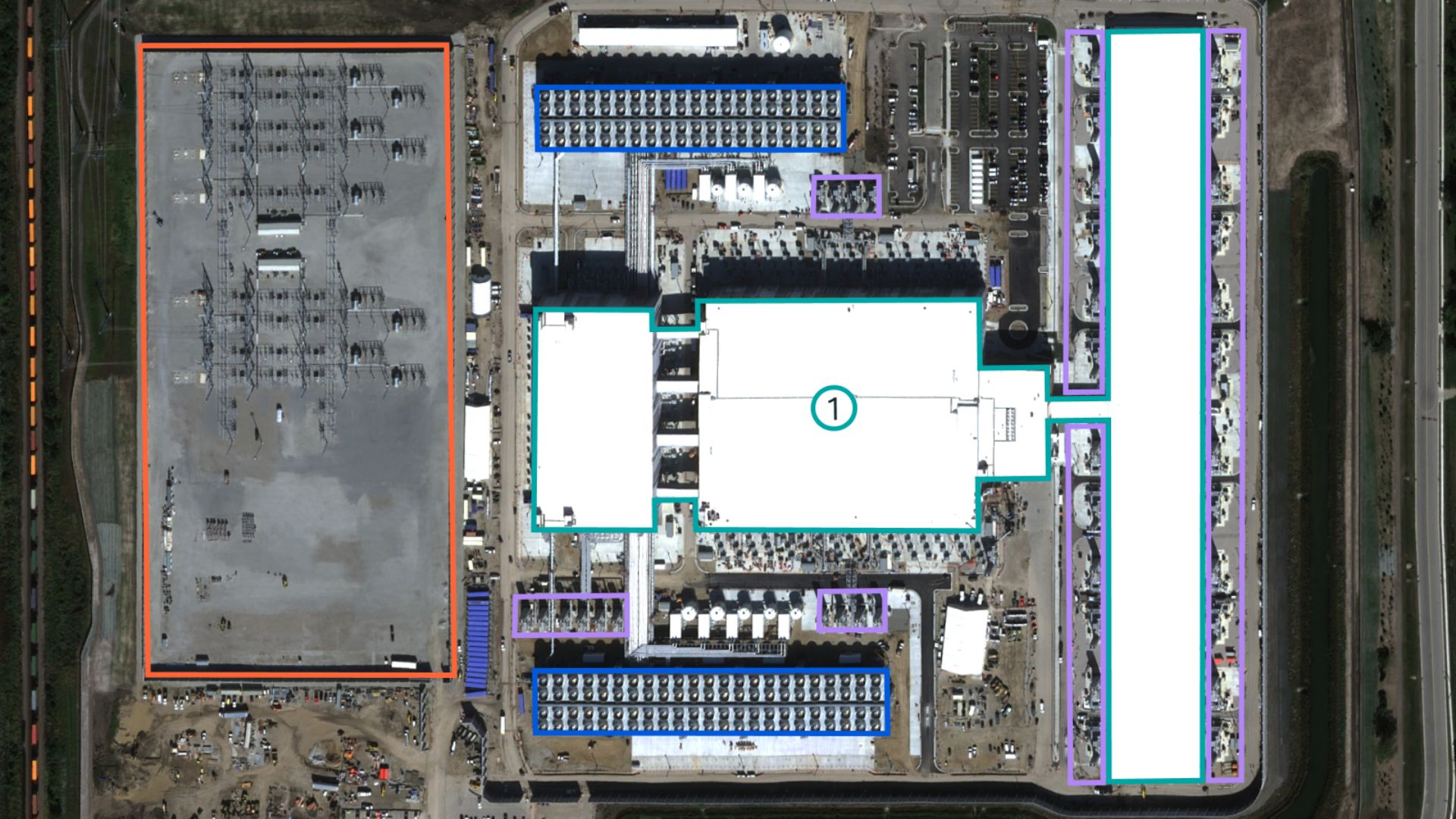
A recent report from 404 Media highlights how a small research team is quietly mapping the rapid expansion of America’s data center infrastructure, using publicly available information and satellite imagery to track facilities often absent from public discussion.
The work comes from Epoch AI, a nonprofit research institute focused on understanding the scale and pace of development of artificial intelligence.
Its researchers use open source intelligence to identify, analyze and document booming data centers in the United States.
By reviewing satellite images, building permits and local regulatory records, the team creates an interactive map that estimates cost, ownership and energy consumption.
The project provides rare visibility into an industry that is growing faster than public scrutiny.
Mapping hidden infrastructure
Data center construction has become a major hot spot across the country. The installations require large amounts of electricity and water.
Many communities only become aware of it after work has begun.
Epoch AI’s map places visual markers at known sites. Each marker links to satellite views and project details. A green circle appears above New Albany, Ohio.
The marker identifies Meta’s “Prometheus” data center complex. AI era estimates the project has cost $18 billion so far. It consumes 691 megawatts of electricity.
“A combination of Meta’s weatherproof tents, colocation facilities and traditional data center buildings, this data center shows Meta’s pivot to AI,” Epoch said in its notes.
Users can scroll through a timeline and watch the complex grow. Satellite images show new buildings and cooling systems added over time.
How Estimates Work
Much of Epoch AI’s analysis focuses on cooling infrastructure. Modern AI systems generate extreme heat. Data centers often place cooling units outside of buildings or on rooftops.
“Modern AI data centers generate so much heat that cooling equipment extends outside the buildings,” Epoch AI explained on its website.
The team counts the fans, measures their size and analyzes their placement.
It integrates these details into a custom model to estimate energy consumption. This power estimate then makes it possible to deduce the computing capacity and the construction cost.
“We focus on cooling because it is a very useful index for determining power consumption,” said Jean-Stanislas Denain, principal researcher at Epoch AI. 404 Media.
The model has uncertainty. Fan speed and configuration vary greatly.
Epoch AI claims that the actual cooling capacity could be twice as high or half as high as estimates.
What remains invisible
The map remains incomplete. State and local disclosure laws vary. Some projects avoid publicity. Small installations often escape detection.
Epoch AI estimates that the current dataset represents approximately 15% of global AI computing delivered by chipmakers as of November 2025.
Zooming out reveals landmarks across the country. The one near Memphis, Tennessee, points to xAI’s Colossus 2 project.
Epoch AI notes that the company has installed natural gas turbines across the Mississippi border, which will likely lead to faster approval.
“Based on this and previous tweets from Elon Musk, 110,000 NVIDIA GB200 GPUs are operational,” Epoch AI wrote.
Even detailed mapping leaves blind spots.
“Even if we have perfect analysis of a data center, we still don’t know who is using it and how much they are using,” the group said.
Epoch AI plans to expand its research globally.
The project aims to highlight the infrastructures that shape the economy of the future, often without public visibility.