





Stanford University has awarded up to two million dollars each in follow-on funding to five interdisciplinary research teams through its Hoffman-Yee Research Grants program, extending work focused on human-centered studies. artificial intelligence in science, health and society.
The funding, administered by Stanford Human-Centered Artificial Intelligence (HAI) and supported by a philanthropic gift from Reid Hoffman and Michelle Yee, builds on initial 2024 awards of five hundred thousand dollars per team. In total, the Hoffman-Yee program has distributed $27.6 million to date, strengthening Stanford’s role as a hub for applied AI research with downstream relevance to education, skills and real-world systems.
Expanded Funding for Human-Centered AI Research
Stanford HAI selected all five teams for its 2024 cohort following a competitive review process that included public presentations at the Hoffman-Yee Symposium and private interviews with a selection committee.
James Landay, co-director of Stanford HAI, says the program is designed to support ambitious work with long-term impact. “Hoffman-Yee Research Grants are awarded to teams that demonstrate boldness, ingenuity and transformative potential in human-centered AI,” he says. “We believe these projects will play an important role in shaping future work in AI, from academia to industry, government and civil society. »
The five teams will continue their research in areas such as generative AI and creativity, biological modeling, public safety, neuroscience and genomics. Several projects also emphasize open source tools and interdisciplinary collaboration, strengthening connections between academic research and workforce development.
From virtual cells to maintaining order and creativity
A funded team is advancing work on a human-centered AI virtual cell, combining large-scale biological data with multimodal AI models. Emma Lundberg, associate professor of bioengineering and pathology at Stanford, says the funding supports a long-term research vision. “This additional funding from Hoffman-Yee allows us to pursue our bold vision of creating virtual cellular models to advance our understanding of drug response,” she says.
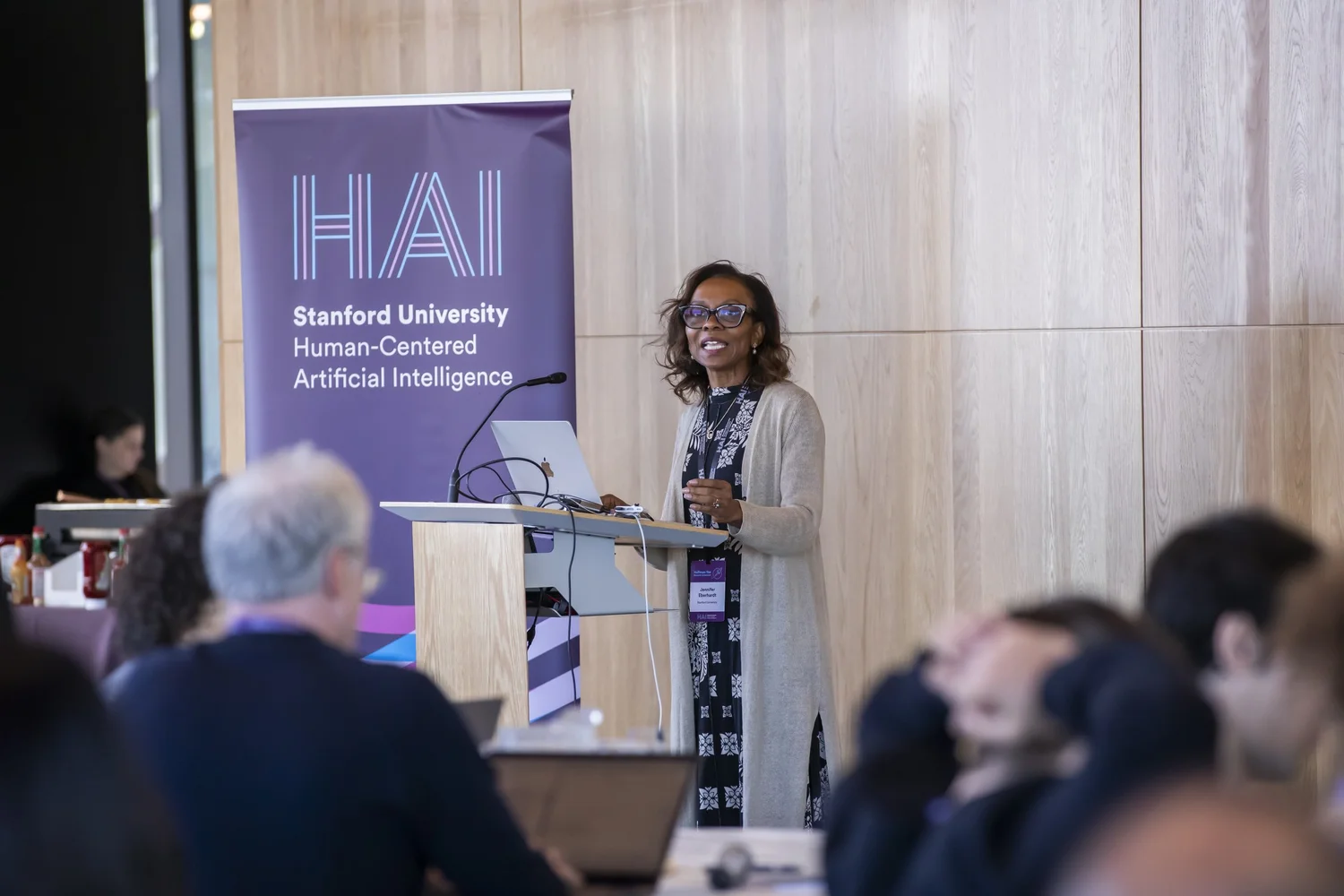
Another team uses AI to analyze images from body-worn cameras, integrating information into law enforcement training and evaluation. Jennifer Eberhardt, a professor of psychology at Stanford and leader of the project, says the scale of the data allows for new forms of analysis. “Our initial results demonstrate the potential of our approach: combining massive data sets, advanced AI tools, and interdisciplinary expertise to assess policy effectiveness and identify practices that reduce escalation and build trust,” she says.
Research on generative AI and creativity is also extensive, with teams exploring how humans and AI systems establish a common conceptual basis when creating visual and immersive content. Early work has already informed product development and helped create new interdisciplinary communities at Stanford.
Several projects directly intersect with education and skills development, notably through the creation of AI assistants, open source tools and new research communities spanning multiple disciplines.
Ehsan Adeli, an assistant professor of psychiatry and behavioral sciences at Stanford, says the Hoffman-Yee funding has enabled interdisciplinary work that would otherwise be difficult to sustain. “This support has created a level of interdisciplinary collaboration that would not have been possible otherwise,” he says, highlighting the challenge of building large-scale fundamental models of the human brain.
The Evo genomics project also continues thanks to the extended funding, with Brian Hie, assistant professor of chemical engineering at Stanford, highlighting the role of early support. “Our work would not be possible without this support,” he says.