
There is no national rule. As a rough guide, schools often close with 1–2 inches of snow in the US South, 3–4 inches in the Mid-Atlantic, about 6 inches in the Midwest and Northeast, and 8–10 inches or more in the snowbelt and Canada. Snow during the morning commute and any freezing rain make closures much more likely.
Ask a student in Atlanta and a student in Buffalo how much snow it takes to cancel school and you will get very different answers. There is no national rule in the United States or Canada. Each district decides for itself, and the answer depends far more on where and when the snow falls than on the total amount.
Want a number for tomorrow? Try our snow day calculator, which uses your local forecast.
The short answer, by region
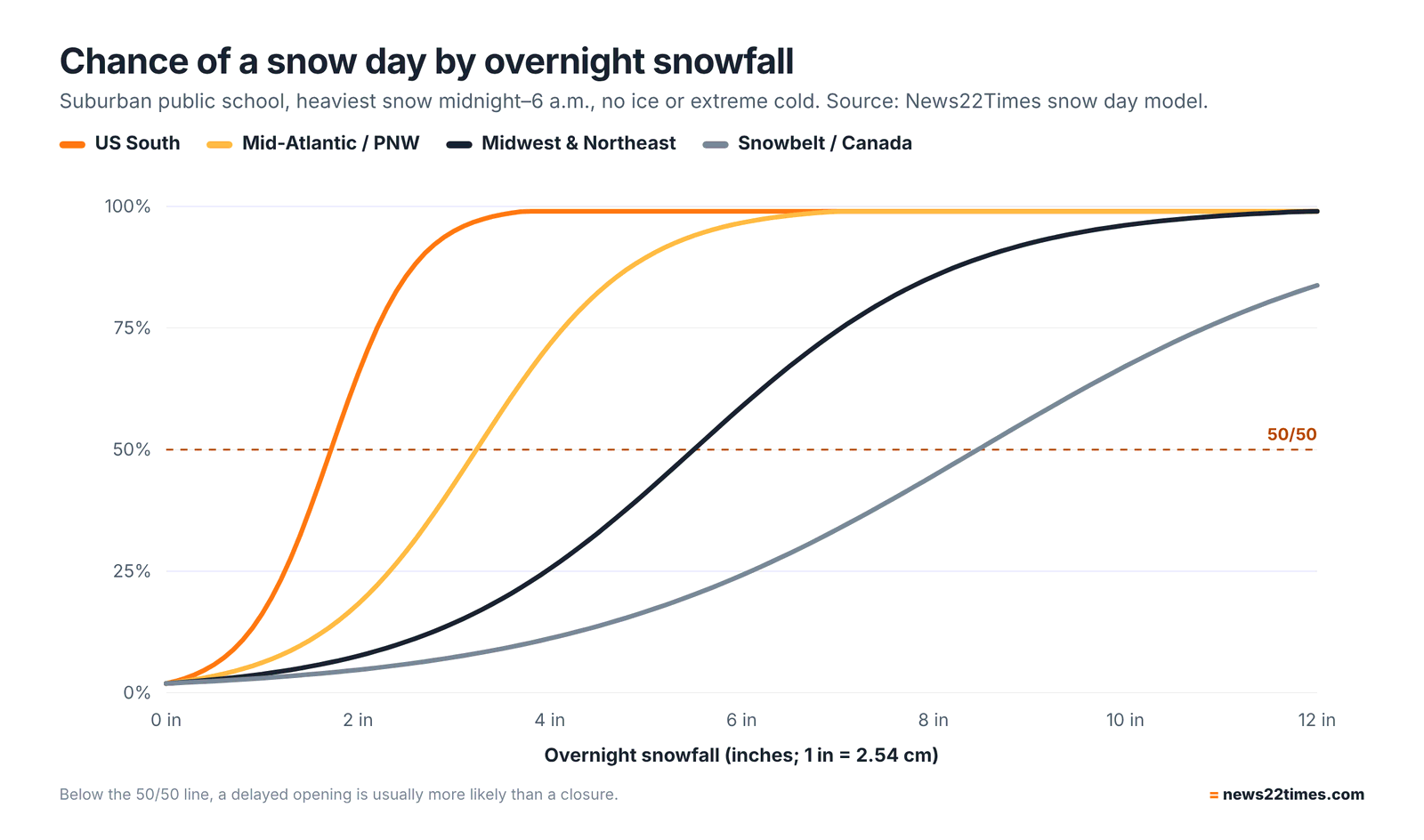
| Region | Snow day more likely than not at about | Why |
|---|---|---|
| US South (Georgia, Texas, the Carolinas…) | 1–2 inches | Few plows and salt trucks; drivers rarely see snow. |
| Mid-Atlantic and Pacific Northwest | 3–4 inches | Snow is occasional; hills and wet snow make roads icy. |
| Midwest, Plains and Northeast | About 6 inches | Good equipment, but long bus routes take time to clear. |
| Snowbelt (Great Lakes), northern states and Canada | 8–10 inches or more | Plows run all night and families are used to winter driving. |
These are estimates from our model for overnight snow at a typical suburban public school. Below these amounts, a delayed opening is usually more likely than a full closure.
Timing beats totals
Six inches that stops falling at 9 p.m. is often cleared by morning. Two inches falling at 6 a.m., just as buses leave the depot, can be more dangerous. That is why so many snow days happen after storms that hit overnight or during the morning commute, and why early-afternoon snow usually leads to an early dismissal rather than a closure the next day.
It is not just snow
- Ice: a quarter inch of freezing rain is more dangerous than 6 inches of snow and closes schools everywhere.
- Extreme cold: many northern districts close or cancel buses when wind chills fall to roughly −20 °F to −35 °F, because children wait outside at bus stops.
- Wind: blowing snow re-covers roads and drifts across rural routes.
- Power outages and building problems: no heat or water also closes schools.
Who decides, and when?
In most districts the superintendent makes the call, usually between 4:30 and 6 a.m. Transportation staff drive bus routes before dawn and talk with road crews, police and neighbouring districts. When a major storm is certain, many districts announce the night before so families can plan.
Urban, suburban and rural schools
Rural districts close more often for the same snow because buses travel long distances on back roads that are plowed last. City districts, with short routes, plowed streets and more students who walk or use transit, close least often. Private schools without bus fleets sometimes stay open when public schools close, or follow the local public district’s decision.
Snow day, delay or remote learning?
A two-hour delay gives crews time to clear roads and lets buses run in daylight, without losing a school day. Since 2020, some districts also call remote learning days instead of traditional snow days, and some states have set rules about how many can count toward the school year. In Canada, boards often cancel buses while keeping schools open.
Do snow days have to be made up?
Usually, yes, if the district falls below the minimum number of instructional days or hours required by its state or province. Most calendars build in a few spare days, and extra closures may be added in spring or by shortening a break. This is why districts that have already used several snow days become more reluctant to close.
How to guess tomorrow
- Check the forecast snowfall by 7 a.m., not the storm total.
- Look for freezing rain or sleet in the forecast.
- Check the overnight low and wind chill.
- Remember your region and your district’s history.
- Run the numbers in our snow day calculator the evening before.
Key facts
- There is no national snowfall threshold for closing schools.
- Schools in the US South may close with 1–2 inches; snowbelt schools often need 8–10 inches.
- A quarter inch of freezing rain can close schools anywhere.
- Most closure decisions are made between 4:30 and 6 a.m.
- Rural districts close more often than city districts for the same snowfall.
Frequently asked questions
How many inches of snow cancel school?
It depends on your region: about 1–2 inches in the US South, 3–4 in the Mid-Atlantic, 6 in the Midwest and Northeast, and 8–10 or more in the snowbelt and Canada.
Who decides to cancel school for snow?
Usually the district superintendent, after transportation staff check the roads early in the morning.
Why do rural schools close more often?
Their buses travel long routes on back roads that are cleared last.
Do snow days have to be made up?
Often, yes, if the district falls below the required number of school days or hours. Many calendars include spare days.
Sources & methodology
Read our full calculation methodology.
News22Times (2026). How Much Snow Does It Take to Cancel School?. Retrieved from https://www.news22times.com/how-much-snow-to-cancel-school/