
A snow day is most likely when several inches of snow or any significant ice fall overnight or during the morning commute. As a rough guide, schools often close with about 2 inches in the US South, 3–4 inches in the Mid-Atlantic, 6 inches in the Midwest and Northeast, and 8–10 inches in the snowbelt and Canada.
How to use the snow day calculator
You can let the calculator fetch tonight's forecast, or type it in yourself from any weather app.
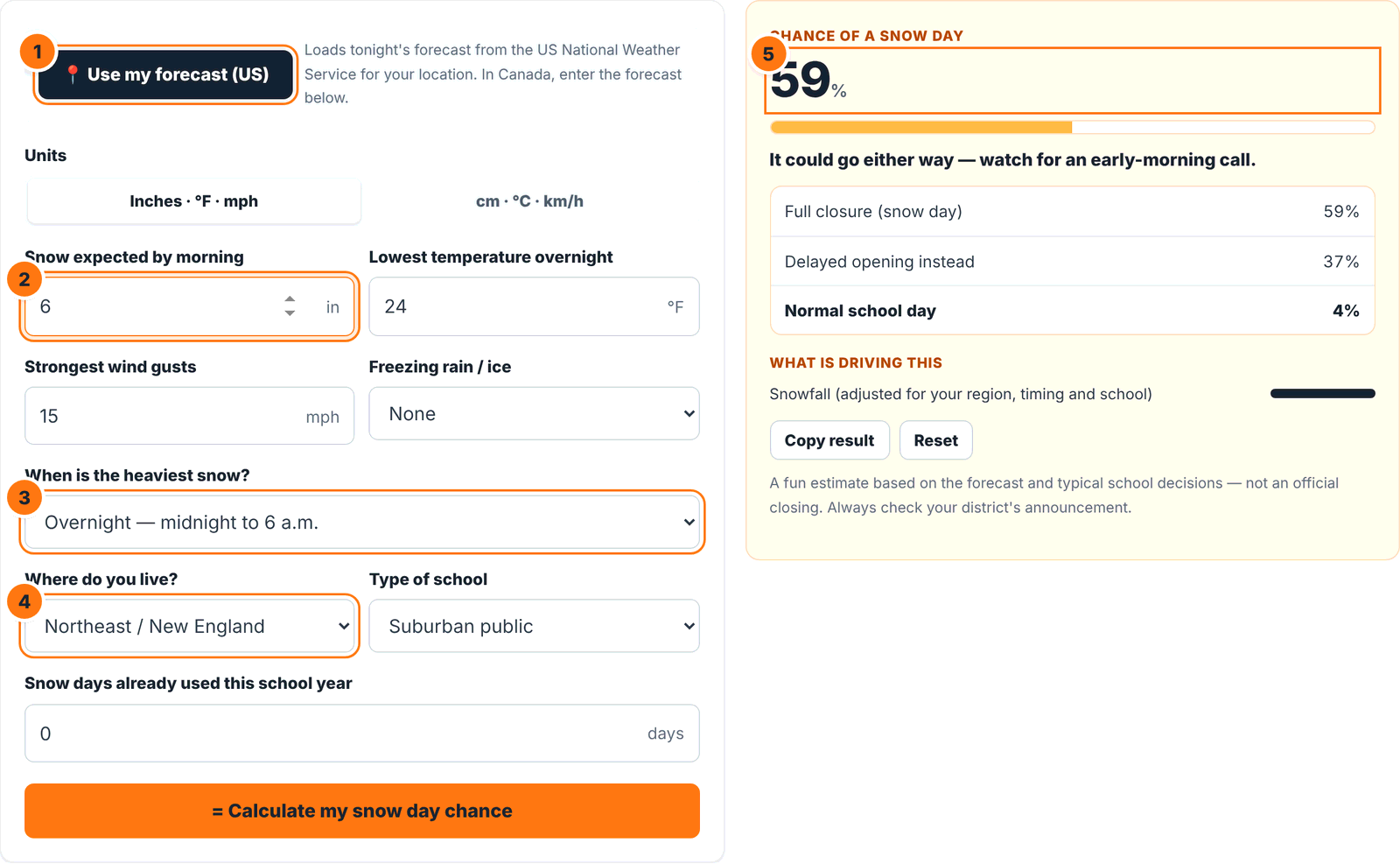
- US: tap Use my forecast and allow location access. The calculator loads the National Weather Service forecast for your exact spot. Canada: enter the forecast from Environment Canada or your weather app, using centimetres and °C.
- Check the snow expected by morning, overnight low, wind gusts and any freezing rain.
- Choose when the heaviest snow falls. Timing matters as much as the amount.
- Pick your region and type of school, and how many snow days your district has already used.
- Read your chance of a full closure and of a delayed opening, plus the factors driving the result.
How our snow day calculator works
School closures are decided by people, usually a superintendent who drives the roads and talks to bus companies and road crews before dawn. No calculator can know what they will decide, but the same factors drive almost every decision. Our model scores each factor, adds them up, and turns the total into a probability. Unlike most snow day calculators, we show you exactly how.
| Factor | How it counts | Why it matters |
|---|---|---|
| Snowfall by morning | Inches of snow, multiplied by your region, timing and school-type factors | More snow means more roads to clear before buses run. |
| Your region | US South × 3.2, Mid-Atlantic × 1.7, Midwest and Northeast × 1.0, snowbelt and Canada × 0.65 | Places that rarely get snow have fewer plows and drivers with less experience. |
| Timing | Evening × 0.55, overnight × 1.0, morning commute × 1.15, after school starts × 0.5 | Snow that stops by midnight can be cleared; snow at 6 a.m. hits buses. |
| School type | Urban × 0.9, suburban × 1.0, rural × 1.2, private × 0.95 | Long rural bus routes on back roads are hardest to clear. |
| Freezing rain | +3 for a light glaze, +7 for ¼ inch (6 mm) or more | Ice is more dangerous than snow and closes schools in every region. |
| Extreme cold | +1 below −5 °F, +3 below −15 °F, +5 below −25 °F | Children waiting at bus stops risk frostbite. |
| Wind | +0.7 for gusts over 30 mph, +1.5 over 45 mph (with snow) | Blowing and drifting snow re-covers cleared roads. |
| Snow days used | −0.25 per day already used (up to 6) | Districts with few make-up days left are more reluctant to close. |
The total score is converted into a chance of a full closure and a separate chance of a delayed start. A score of about 5.5 is a coin flip.
How much snow does it take to cancel school?
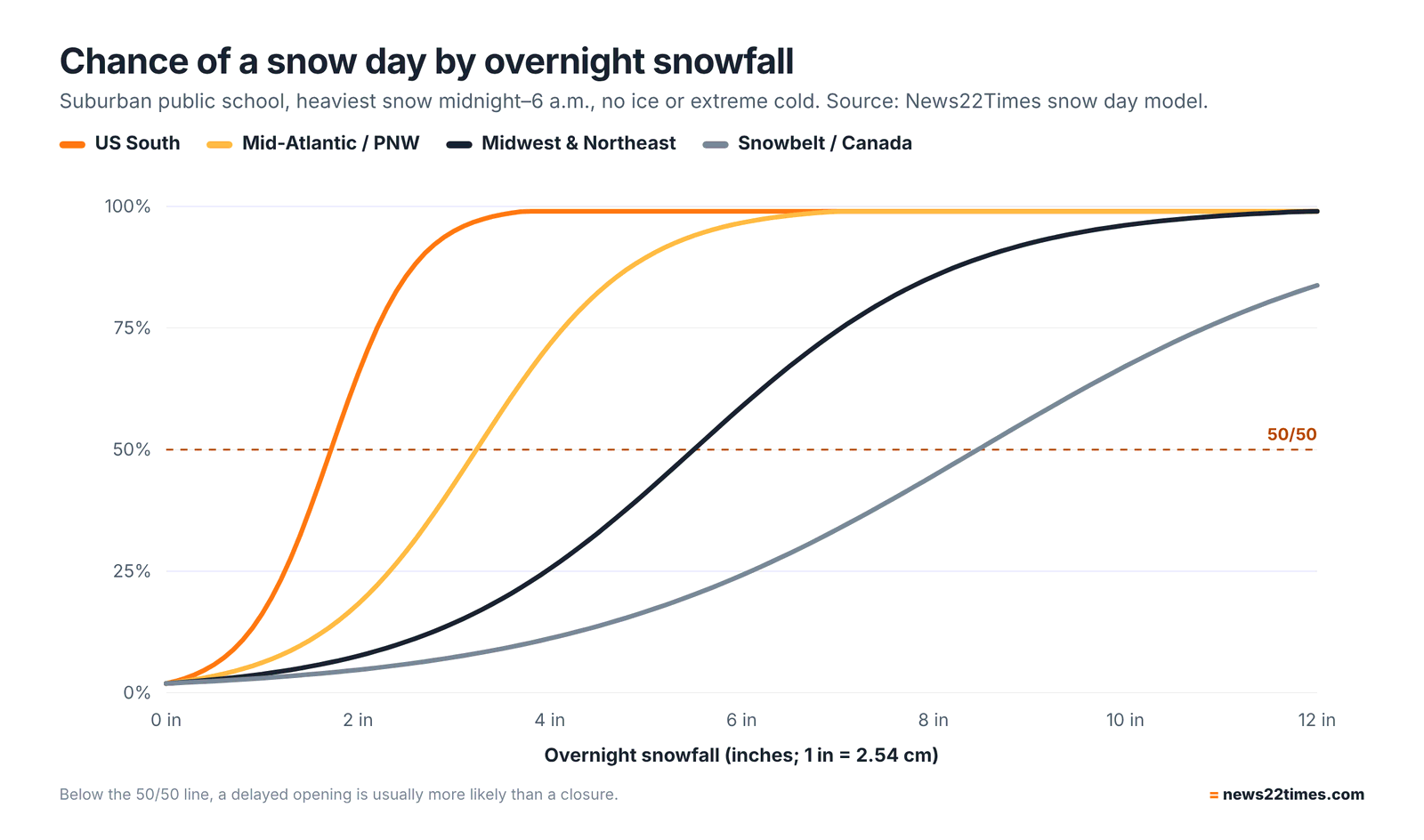
There is no national rule. The same 4 inches that barely slows a school in Buffalo can shut down a whole district in Atlanta. Here is what our model gives for overnight snow at a suburban public school, with no ice or extreme cold:
| Overnight snow | US South | Mid-Atlantic / PNW | Midwest / Northeast | Snowbelt / Canada |
|---|---|---|---|---|
| 1 inch (2.5 cm) | 16% | 6% | 4% | 3% |
| 2 inches (5 cm) | 66% | 18% | 8% | 5% |
| 4 inches (10 cm) | 99% | 72% | 26% | 11% |
| 6 inches (15 cm) | 99% | 97% | 59% | 24% |
| 8 inches (20 cm) | 99% | 99% | 86% | 45% |
| 12 inches (30 cm) | 99% | 99% | 99% | 84% |
Roughly, a closure becomes more likely than not at about 2 inches in the South, 3–4 inches in the Mid-Atlantic, 6 inches in the Midwest and Northeast, and 8–10 inches in the snowbelt and most of Canada. Below those amounts, a delayed opening is the more likely outcome.
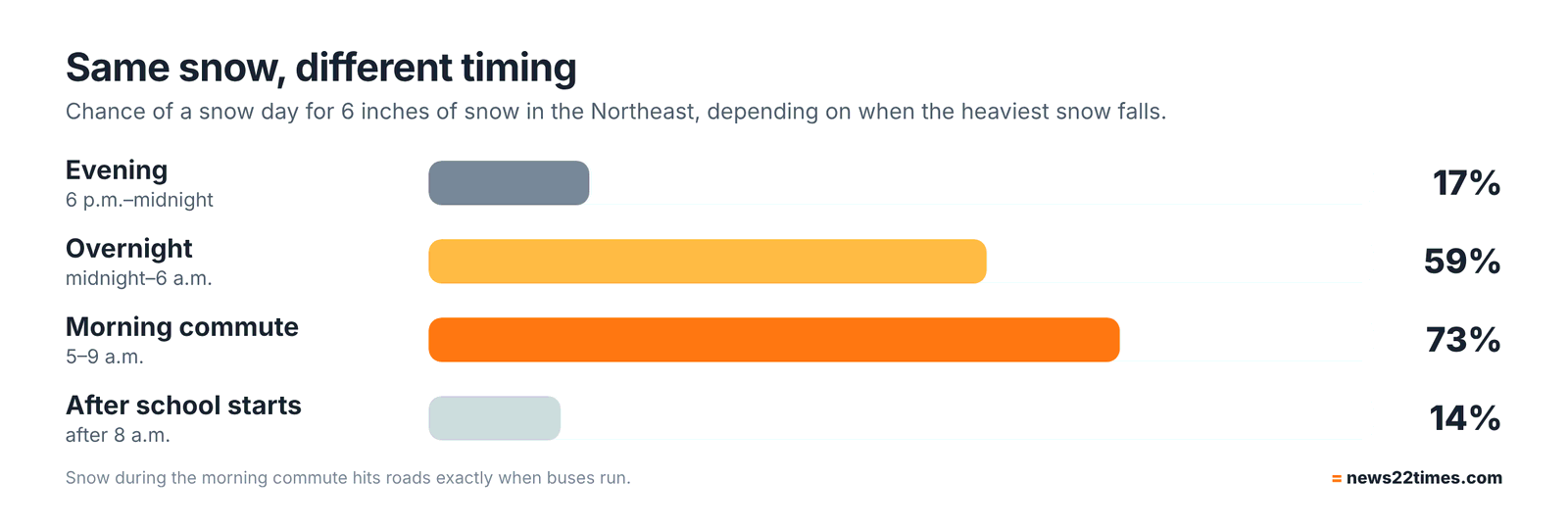
Why timing matters as much as the amount
| When the heaviest snow falls | Chance with 6 in overnight-equivalent (Northeast) | What usually happens |
|---|---|---|
| Evening, ends before midnight | 17% | Crews clear roads overnight; school opens or is delayed. |
| Overnight, midnight to 6 a.m. | 59% | The toughest call; decided at about 5 a.m. |
| Morning commute, 5 to 9 a.m. | 73% | Roads are worst exactly when buses run. |
| After school starts | 14% | Schools usually stay open and may dismiss early. |
Ice, extreme cold and wind
Snow is not the only reason schools close. A quarter inch of freezing rain makes roads and sidewalks treacherous and can bring down power lines, so ice storms close schools even where snow rarely does. On its own, significant ice gives a 74% chance of a closure in our model.
Many northern districts also close or cancel buses for extreme cold, usually when the wind chill is forecast somewhere around −20 °F to −35 °F (about −29 °C to −37 °C). The exact threshold varies by district. Check the National Weather Service wind chill chart and your district's policy.
Snow day, delay or remote learning day?
- Snow day (closure): school is cancelled for everyone. Most districts build a few into the calendar and make up extra days later.
- Delayed opening: school starts one to three hours late so roads can be cleared and it gets light. Often the outcome with 2–5 inches of overnight snow.
- Early dismissal: when snow starts during the school day.
- Remote learning day: some districts now switch to online learning instead of a traditional snow day. Rules differ by state and district.
- Buses cancelled, schools open: common in Canada and rural areas, where schools stay open for students who can get there.
How schools decide to close
- The day before, district leaders watch the forecast and talk with neighbouring districts.
- From about 3 to 5 a.m., transportation staff drive bus routes and check road conditions with road crews and police.
- The superintendent makes the call, usually by 5:30 to 6 a.m. so families and staff can plan.
- The decision goes out by text, email, phone call, the district website, social media and local TV and radio.
How accurate are snow day calculators?
No snow day calculator, including ours, knows what your superintendent will decide. They are fun, well-informed estimates. Accuracy depends mostly on the forecast: if the storm brings half the snow expected, or arrives six hours later, the real outcome changes. For the best estimate, run the calculator again in the evening with the latest forecast and set your region and school type carefully. Your district's official announcement is the only final answer.
Snow days in Canada
Canadian schools are built for winter, so full closures need more snow than in most of the US. More often, school boards cancel buses while keeping schools open. Use the metric setting, choose "Snowbelt, northern states or Canada" and enter the forecast from Environment and Climate Change Canada. Freezing rain is a common reason for bus cancellations in Ontario and Quebec.
Snow day superstitions (just for fun)
- Wear your pajamas inside out.
- Put a spoon under your pillow.
- Flush ice cubes down the toilet (one per inch you want).
- Do a snow dance before bed.
None of these change the forecast. Finish your homework just in case.
Key facts
- Timing matters: snow during the 5–9 a.m. commute is the most likely to close schools.
- A quarter inch of freezing rain can close schools in any region.
- Schools in the US South can close with about 2 inches of snow; snowbelt and Canadian schools usually need 8 inches or more.
- Most districts announce closures between 5:30 and 6 a.m.
- Many northern districts close for wind chills around −20 °F to −35 °F.
Frequently asked questions
How accurate is the snow day calculator?
It is an estimate, not a prediction of your district's decision. Accuracy depends mostly on the forecast, so check again the evening before with the latest forecast. Only your district's announcement is official.
How much snow does it take to close school?
It depends on where you live. In our model a closure becomes more likely than not at about 2 inches in the US South, 3–4 inches in the Mid-Atlantic, 6 inches in the Midwest and Northeast, and 8–10 inches in the snowbelt and Canada.
What time do schools announce snow days?
Usually between 5:30 and 6 a.m., after staff have checked the roads. Some districts announce the night before when a big storm is certain.
What temperature is too cold for school?
There is no single rule. Many northern districts close or cancel buses when the wind chill is forecast around −20 °F to −35 °F (about −29 °C to −37 °C).
Does freezing rain cause snow days?
Yes. Ice is more dangerous than snow for buses and walkers, so even a quarter inch of freezing rain can close schools.
Why is a delay more likely than a snow day?
With moderate overnight snow, a one- or two-hour delay gives crews time to clear roads without losing a full day of school.
Does the calculator work in Canada?
Yes. Switch to metric units, choose "Snowbelt, northern states or Canada" and enter the forecast from Environment Canada. Many Canadian boards cancel buses rather than close schools.
Do snow day superstitions work?
No, but wearing your pajamas inside out is still a classic.
Sources & methodology
- National Weather Service API (forecast data)
- National Weather Service — Wind chill chart
- Environment and Climate Change Canada — Weather
- N22 calculation methodology
Read our full calculation methodology.
News22Times (2026). Snow Day Calculator. Retrieved from https://www.news22times.com/snow-day-calculator/Results are estimates for general information only and are not financial, tax or legal advice. Always confirm with an official source or a qualified professional. See our disclaimer.