
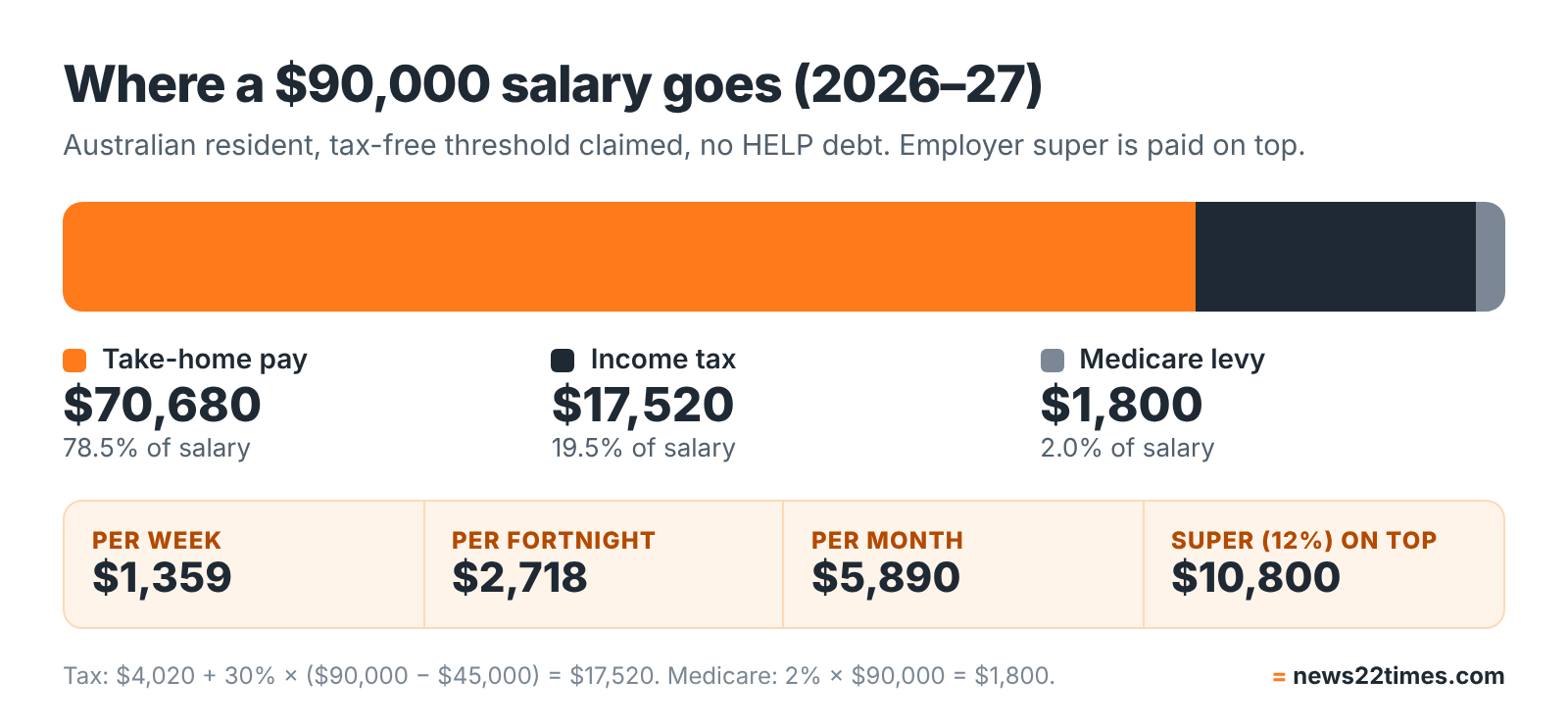
On a $90,000 salary in 2026–27, an Australian resident pays $17,520 income tax and a $1,800 Medicare levy, leaving $70,680 take-home pay: $5,890 a month, $2,718 a fortnight or $1,359 a week. The employer adds $10,800 (12%) super on top.
How to use the pay calculator
Enter your pay the way it appears in your contract or job ad, and the calculator works out your income tax, Medicare levy, any HELP (HECS) repayment and your employer's super, then shows what lands in your bank account each week, fortnight, month and year.
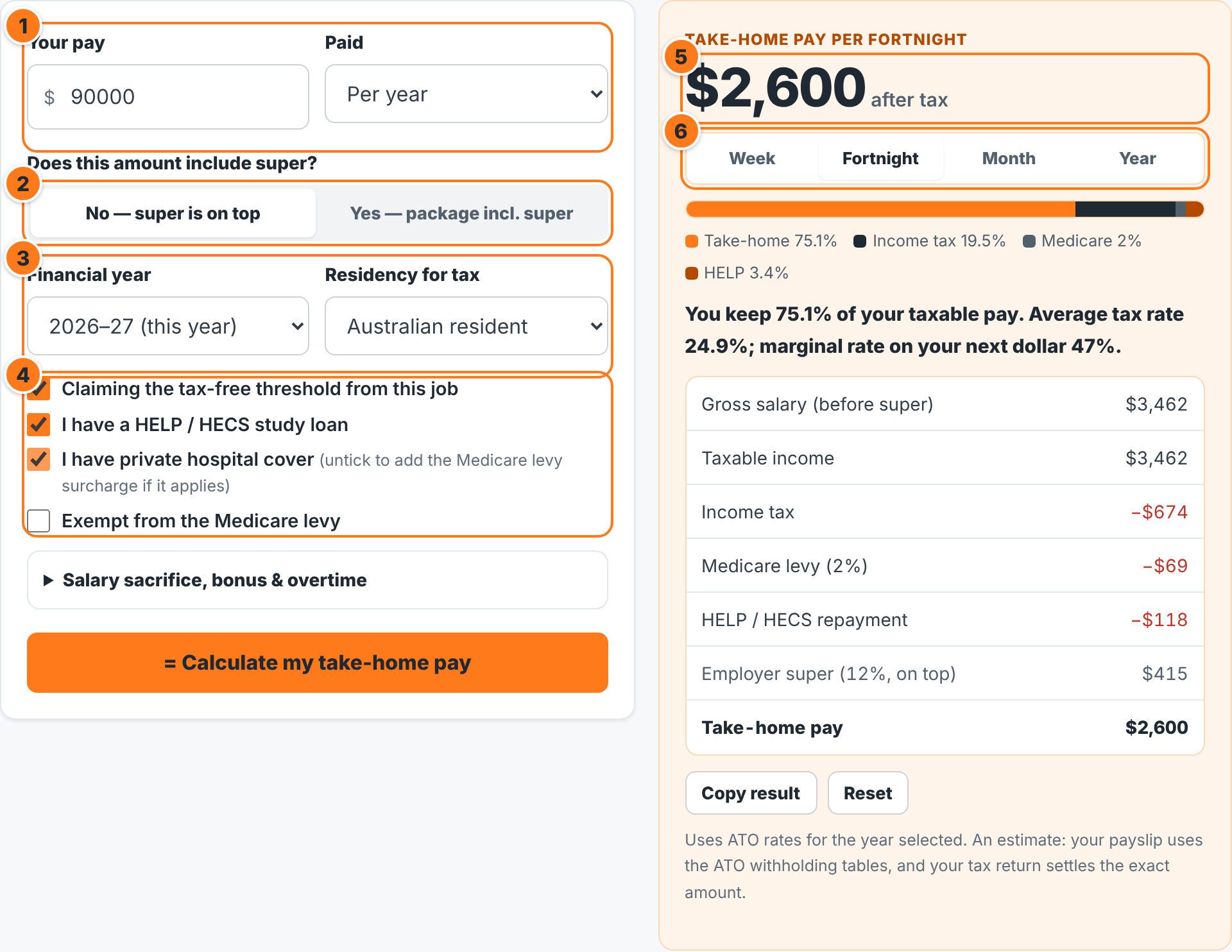
- Enter your pay and choose whether it is per year, month, fortnight, week or hour. For hourly pay, add your usual hours per week.
- Super on top or included? Most salaries are quoted "plus super". If your offer says "$100,000 package including super", choose Yes — package incl. super and the calculator separates the 12% super for you.
- Pick the financial year. 2026–27 is the year running from 1 July 2026 to 30 June 2027. Use 2025–26 to check last year's tax return.
- Choose your residency for tax. Australian residents get the $18,200 tax-free threshold; foreign residents and working holiday makers are taxed from the first dollar.
- Tick what applies: claiming the tax-free threshold from this job, a HELP/HECS debt, private hospital cover, or a Medicare levy exemption.
- Optional: open Salary sacrifice, bonus & overtime to add pre-tax super contributions or extra taxable pay.
- Switch the result between week, fortnight, month and year. The coloured bar shows where every dollar of your taxable pay goes.
Australian income tax rates 2026–27
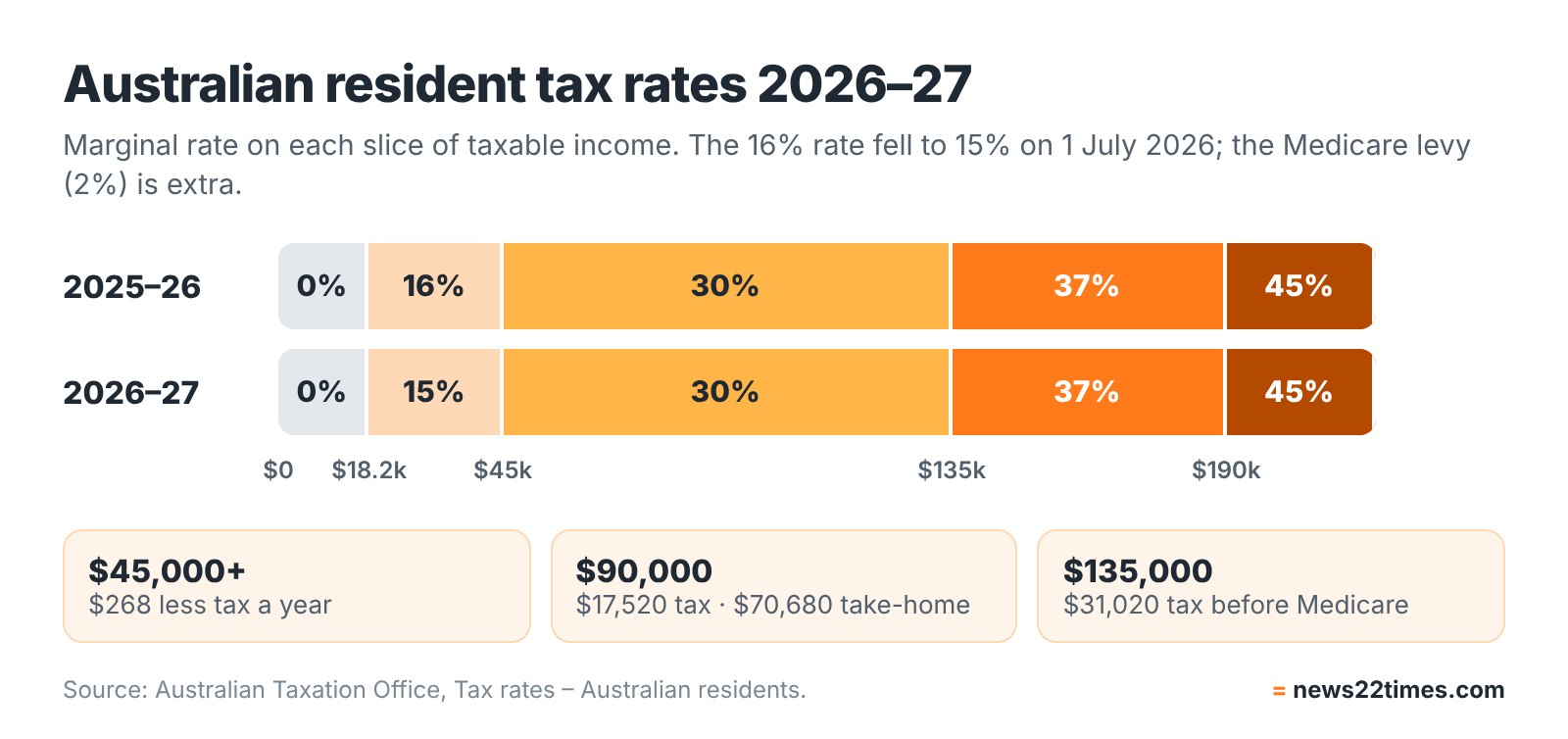
From 1 July 2026 the tax rate on income between $18,201 and $45,000 fell from 16% to 15%. The other brackets are unchanged from the Stage 3 tax cuts that started on 1 July 2024. These are the resident rates published by the Australian Taxation Office (ATO) for 2026–27. They do not include the 2% Medicare levy.
| Taxable income | Tax on this income (2026–27) |
|---|---|
| $0 – $18,200 | Nil |
| $18,201 – $45,000 | 15c for each $1 over $18,200 |
| $45,001 – $135,000 | $4,020 plus 30c for each $1 over $45,000 |
| $135,001 – $190,000 | $31,020 plus 37c for each $1 over $135,000 |
| $190,001 and over | $51,370 plus 45c for each $1 over $190,000 |
What changed from 2025–26
| Taxable income | 2025–26 | 2026–27 |
|---|---|---|
| $18,201 – $45,000 | 16% | 15% |
| $45,001 – $135,000 | $4,288 + 30% | $4,020 + 30% |
| $135,001 – $190,000 | $31,288 + 37% | $31,020 + 37% |
| $190,001 and over | $51,638 + 45% | $51,370 + 45% |
Anyone with a taxable income of $45,000 or more pays $268 less tax in 2026–27 than in 2025–26, about $5.15 a week. Below $45,000 the saving is 1% of every dollar over $18,200.
How take-home pay is calculated
Your take-home (net) pay is what is left after your employer withholds tax through the Pay As You Go (PAYG) system. For a resident claiming the tax-free threshold the calculation is:
Take-home pay = Taxable income − (income tax − low income tax offset) − Medicare levy − HELP repayment − Medicare levy surcharge (if it applies)
Superannuation is not taken out of your pay. Your employer pays the 12% super guarantee into your super fund on top of your salary, so it does not reduce your take-home pay unless your salary is quoted as a package that includes super.
Worked example: $90,000 salary plus super (2026–27)
- Taxable income: $90,000.
- Income tax: $4,020 + 30% × ($90,000 − $45,000) = $4,020 + $13,500 = $17,520.
- Low income tax offset: $0 (it phases out completely at $66,667).
- Medicare levy: 2% × $90,000 = $1,800.
- Take-home pay: $90,000 − $17,520 − $1,800 = $70,680 a year, which is $5,890 a month, $2,718 a fortnight or $1,359 a week.
- Your employer also pays 12% × $90,000 = $10,800 into your super fund.
With a HELP debt the same person would also repay 15% × ($90,000 − $69,528) = $3,071, leaving $67,609.
Take-home pay for common salaries (2026–27)
Australian resident, claiming the tax-free threshold, no HELP debt, full Medicare levy, super paid on top. Figures are rounded to the nearest dollar.
| Salary | Tax + Medicare | Per year | Per month | Per fortnight | Per week |
|---|---|---|---|---|---|
| $30,000 | $1,269 | $28,731 | $2,394 | $1,105 | $553 |
| $50,000 | $6,270 | $43,730 | $3,644 | $1,682 | $841 |
| $60,000 | $9,620 | $50,380 | $4,198 | $1,938 | $969 |
| $70,000 | $12,920 | $57,080 | $4,757 | $2,195 | $1,098 |
| $80,000 | $16,120 | $63,880 | $5,323 | $2,457 | $1,228 |
| $90,000 | $19,320 | $70,680 | $5,890 | $2,718 | $1,359 |
| $100,000 | $22,520 | $77,480 | $6,457 | $2,980 | $1,490 |
| $120,000 | $28,920 | $91,080 | $7,590 | $3,503 | $1,752 |
| $150,000 | $39,570 | $110,430 | $9,202 | $4,247 | $2,124 |
| $200,000 | $59,870 | $140,130 | $11,678 | $5,390 | $2,695 |
The Medicare levy and low-income reduction
Most residents pay a Medicare levy of 2% of their taxable income. People on low incomes pay less or nothing. For a single person the latest published thresholds are:
| Taxable income (single) | Medicare levy |
|---|---|
| $28,011 or less | Nil |
| $28,012 – $35,013 | 10c for each $1 over $28,011 (phase-in) |
| Over $35,013 | 2% of your whole taxable income |
Seniors and pensioners have higher thresholds ($44,268 and $55,335), and family thresholds are higher again. The ATO indexes these thresholds each year; the calculator uses the latest figures the ATO has published. You can be fully or partly exempt if, for example, you are a foreign resident, a member of the Defence Force, or not entitled to Medicare benefits. Tick Exempt from the Medicare levy if that applies to you.
Medicare levy surcharge (MLS) 2026–27
If you earn above the MLS threshold and do not hold an appropriate level of private patient hospital cover, you pay an extra surcharge on top of the Medicare levy. Income for MLS purposes includes your taxable income plus reportable super contributions such as salary sacrifice.
| Tier | Single income | Family income | Surcharge |
|---|---|---|---|
| Base tier | $105,000 or less | $210,000 or less | 0% |
| Tier 1 | $105,001 – $123,000 | $210,001 – $246,000 | 1% |
| Tier 2 | $123,001 – $164,000 | $246,001 – $328,000 | 1.25% |
| Tier 3 | $164,001 or more | $328,001 or more | 1.5% |
For 2025–26 the single thresholds were $101,000, $118,000 and $158,000. The family threshold rises by $1,500 for each dependent child after the first. Example: a single person earning $120,000 with no hospital cover pays 1% × $120,000 = $1,200 of MLS in 2026–27, which is often more than a basic hospital policy costs.
HELP (HECS) repayments 2026–27
Since 2025–26, compulsory study loan repayments use marginal rates: you repay a percentage of the income above the threshold, not of your whole income. The thresholds apply to every study and training loan, including HELP, VET Student Loans and Australian Apprenticeship Support Loans.
| Repayment income | Repayment (2026–27) |
|---|---|
| $0 – $69,528 | Nil |
| $69,529 – $129,717 | 15c for each $1 over $69,528 |
| $129,718 – $186,050 | $9,028 plus 17c for each $1 over $129,717 |
| $186,051 and over | 10% of your total repayment income |
Repayment income is your taxable income plus items such as reportable super contributions, reportable fringe benefits and net investment losses. In 2025–26 the first threshold was $67,000. Your employer withholds an amount from each pay; the exact repayment is worked out when you lodge your tax return, and it can never be more than the balance you owe.
Superannuation: 12% on top, packages and salary sacrifice
The super guarantee rate is 12% of your ordinary time earnings. It is paid by your employer into your super fund and is not part of your take-home pay. Super used to be paid quarterly; from 1 July 2026 the ATO's quarterly super rules ended and employers pay super when they pay wages (Payday Super), so it should reach your fund soon after each payday.
- "$90,000 plus super": your salary is $90,000 and your employer adds $10,800 of super.
- "$90,000 package including super": your salary is $90,000 ÷ 1.12 = $80,357, and super is $9,643. Choose the package option so the calculator does this for you.
- Salary sacrifice: you ask your employer to pay part of your pre-tax salary into super. It lowers your taxable income, so you pay less income tax, while the money is taxed at 15% in the fund instead.
Salary sacrifice example
On a $90,000 salary, sacrificing $5,000 a year into super reduces taxable income to $85,000. Income tax and Medicare fall from $19,320 to $17,720, so take-home pay drops by only $3,400 while $5,000 goes into super (about $4,250 after the 15% contributions tax). Salary sacrifice and employer super both count towards your concessional contributions cap, so check the current cap with the ATO before you sacrifice large amounts.
The tax-free threshold and a second job
Residents pay no tax on the first $18,200 of income each year, but you should normally claim the tax-free threshold from only one employer, usually the one that pays you most. A second employer then withholds tax from the first dollar it pays you.
Untick Claiming the tax-free threshold to see roughly what a second job withholds. Over-withholding is not lost: your tax return combines all your income and refunds anything extra. If you claim the threshold from two jobs, too little tax is usually withheld and you may get a bill at tax time.
Low income tax offset (LITO)
The low income tax offset reduces the tax of residents on lower incomes. It is applied automatically in your tax return, and the calculator includes it.
| Taxable income | Offset |
|---|---|
| $37,500 or less | $700 |
| $37,501 – $45,000 | $700 minus 5c for each $1 over $37,500 |
| $45,001 – $66,667 | $325 minus 1.5c for each $1 over $45,000 |
| $66,668 or more | Nil |
With the tax-free threshold and LITO combined, a resident pays no income tax on taxable income up to about $22,900 in 2026–27.
Foreign residents and working holiday makers
Foreign residents for tax purposes do not get the tax-free threshold, the low income tax offset or the Medicare levy. Working holiday makers (visa subclass 417 or 462) are taxed at 15% from their first dollar up to $45,000. The ATO currently lists these rates for 2025–26; the calculator uses them for 2026–27 until new figures are published.
| Taxable income | Foreign resident | Working holiday maker |
|---|---|---|
| $0 – $45,000 | 30% | 15% |
| $45,001 – $135,000 | 30% | $6,750 + 30% over $45,000 |
| $135,001 – $190,000 | $40,500 + 37% over $135,000 | $33,750 + 37% over $135,000 |
| $190,001 and over | $60,850 + 45% over $190,000 | $54,100 + 45% over $190,000 |
Hourly, weekly and fortnightly pay
The calculator converts any pay period to an annual figure, because Australian tax rates are annual. A year is treated as 52 weeks, 26 fortnights or 12 months.
| Hourly rate (38-hour week) | Per week | Per year (gross) | Take-home per week |
|---|---|---|---|
| $25.00 | $950 | $49,400 | $833 |
| $30.00 | $1,140 | $59,280 | $960 |
| $35.00 | $1,330 | $69,160 | $1,087 |
| $40.00 | $1,520 | $79,040 | $1,216 |
| $50.00 | $1,900 | $98,800 | $1,474 |
Casual employees usually receive a 25% casual loading instead of paid leave, which is already included in their hourly rate.
Why your payslip may be slightly different
- Withholding tables: employers use the ATO's weekly, fortnightly and monthly withholding schedules, which round amounts and can differ from the annual tax by a few dollars a pay.
- Pay frequency: some years have 53 weekly or 27 fortnightly pays, so each pay is slightly smaller than a simple division.
- Allowances, overtime and leave loading may be taxed differently in each pay.
- Deductions such as union fees, workplace giving or salary-packaged items reduce your net pay but are not tax.
- Tax return: work-related deductions, other income and private health insurance rebates are settled when you lodge your return.
Pay calculator vs. your tax return
This calculator estimates your tax for a full year from one income. Your actual tax is worked out after 30 June, when your tax return combines all your income and deductions. The ATO also has its own tax withheld calculator for employers and an income tax estimator, which you can use to check our results.
Key facts
- 2026–27 resident tax rates: 0% to $18,200, 15% to $45,000, 30% to $135,000, 37% to $190,000, 45% above.
- The 16% rate fell to 15% from 1 July 2026, saving $268 a year for anyone earning $45,000 or more.
- The Medicare levy is 2% of taxable income, with a low-income reduction.
- The super guarantee is 12% of ordinary time earnings, paid on top of salary.
- HELP repayments start at $69,529 of repayment income in 2026–27 and use marginal rates.
- The Medicare levy surcharge starts above $105,000 (single) without private hospital cover in 2026–27.
Frequently asked questions
How much tax do I pay on $100,000 in Australia?
In 2026–27 a resident pays $20,520 income tax and a $2,000 Medicare levy on $100,000, so take-home pay is $77,480 a year, about $2,980 a fortnight. With a HELP debt, add a $4,571 repayment.
What are the tax brackets for 2026–27?
0% up to $18,200; 15% from $18,201 to $45,000; 30% from $45,001 to $135,000; 37% from $135,001 to $190,000; and 45% above $190,000. The 2% Medicare levy is extra.
Is super included in my take-home pay?
No. Your employer pays 12% super into your fund on top of your salary. If your offer is a package including super, divide it by 1.12 to find your base salary.
How do I calculate my fortnightly pay?
Work out your annual take-home pay and divide by 26. On $90,000 that is $70,680 ÷ 26 = $2,718 a fortnight.
Should I claim the tax-free threshold?
Claim it from one employer only, usually your main job. If you claim it from two employers, too little tax is withheld and you may owe tax when you lodge your return.
How much is taken out for HECS?
From 2025–26 you repay a percentage of income above the threshold. In 2026–27 it is 15c for each dollar between $69,528 and $129,717, then 17c up to $186,050, and 10% of total income above that.
What is the Medicare levy surcharge?
An extra 1% to 1.5% charged on singles earning over $105,000 (families over $210,000) in 2026–27 who do not have private hospital cover.
Why is my payslip different from the calculator?
Employers use the ATO withholding tables, which round each pay. Allowances, leave loading and other deductions also change your pay, and your tax return settles the exact tax.
How is tax calculated for working holiday makers?
Working holiday makers pay 15% on income up to $45,000, then the same rates as residents above that, with no tax-free threshold and no Medicare levy.
Does salary sacrifice reduce my tax?
Yes. Salary sacrificed into super comes out before tax, so your taxable income falls. The contribution is taxed at 15% in your super fund, which is lower than most people's marginal rate.
Sources & methodology
- ATO — Tax rates: Australian residents
- ATO — Low income tax offset
- ATO — Medicare levy reduction for low-income earners
- ATO — Medicare levy surcharge thresholds and rates
- ATO — Study and training loan repayment thresholds and rates
- ATO — How much super to pay (12% from 1 July 2025)
- N22 calculation methodology
Read our full calculation methodology.
News22Times (2026). Pay Calculator Australia 2026–27: Take-Home Pay After Tax. Retrieved from https://www.news22times.com/pay-calculator-australia/Results are estimates for general information only and are not financial, tax or legal advice. Always confirm with an official source or a qualified professional. See our disclaimer.