
Stamp duty on a $750,000 established home bought to live in ranges from $19,208 in the ACT and $19,600 in Queensland to $27,937 in NSW and $40,070 in Victoria (November 2026 rates). First home buyers in NSW pay no duty up to $800,000.
How to use the stamp duty calculator
Stamp duty (called transfer duty in most states) is a one-off tax you pay when you buy property. Each state and territory sets its own rates and concessions, so the calculator applies the rules of the state you choose, and shows the same purchase in every other state for comparison.
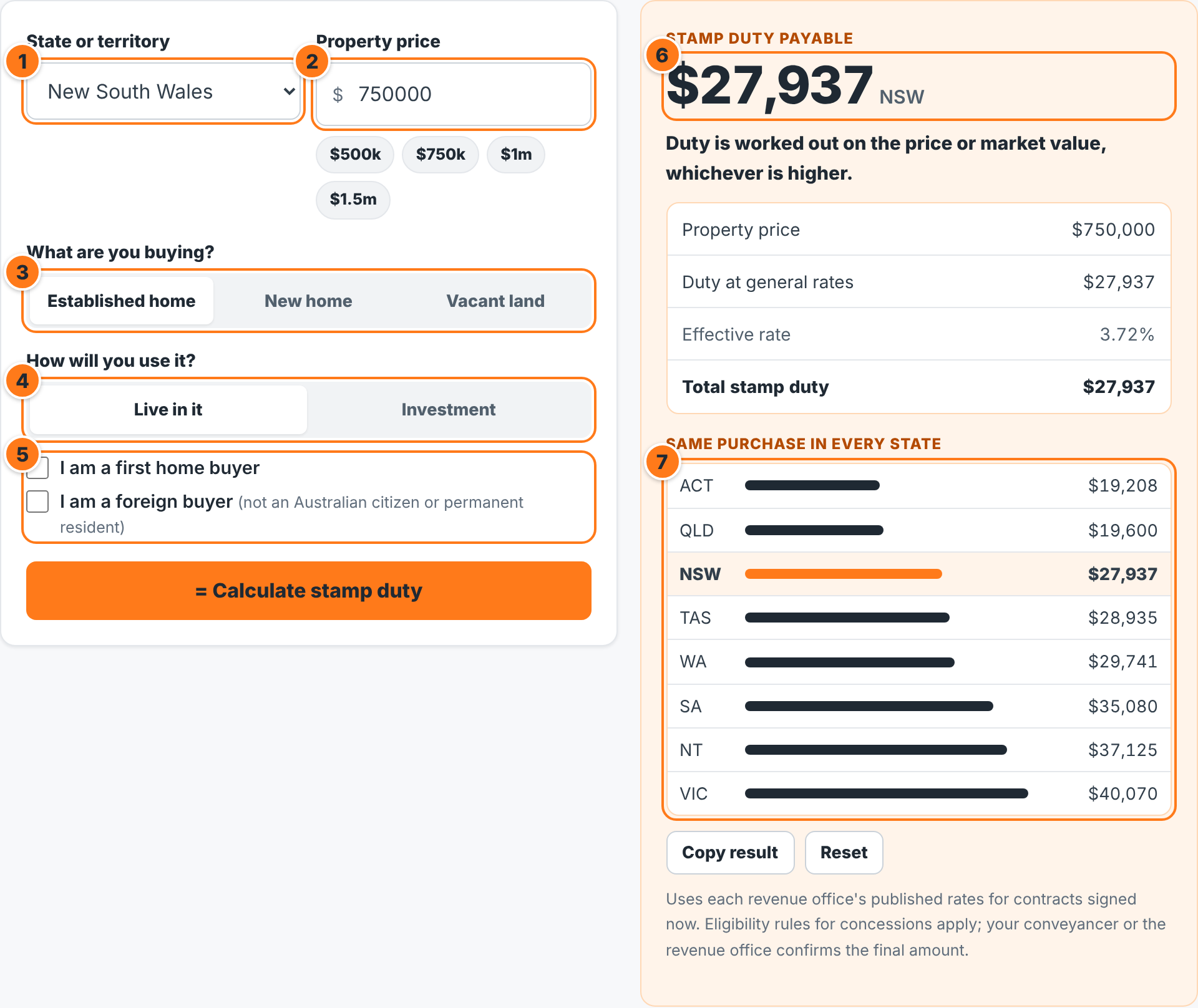
- Choose the state or territory where the property is.
- Enter the price. Duty is charged on the contract price or the market value, whichever is higher. Tap a chip for a quick estimate.
- Pick the property type: established home, new home (never lived in) or vacant land. Several first home buyer schemes treat these differently.
- Live in it or invest? Owner-occupiers get lower rates in Victoria, Queensland, Western Australia and the ACT.
- Tick first home buyer to apply your state's exemption or concession, and foreign buyer to add any foreign purchaser surcharge.
- Read the duty, the concession you saved, your effective rate, and the comparison across all eight states and territories.
Stamp duty on a $750,000 home in every state
For an established home bought to live in by someone who is not a first home buyer, at the rates that apply to contracts signed in November 2026:
| State or territory | Stamp duty | Effective rate | First home buyer pays |
|---|---|---|---|
| Australian Capital Territory | $19,208 | 2.56% | $0 (Home Buyer Concession) |
| Queensland | $19,600 | 2.61% | $10,925 |
| New South Wales | $27,937 | 3.72% | $0 |
| Tasmania | $28,935 | 3.86% | $28,935 |
| Western Australia | $29,741 | 3.97% | $24,225 |
| South Australia | $35,080 | 4.68% | $35,080 (new homes $0) |
| Northern Territory | $37,125 | 4.95% | $37,125 |
| Victoria | $40,070 | 5.34% | $40,070 (exemption ends at $750,000) |
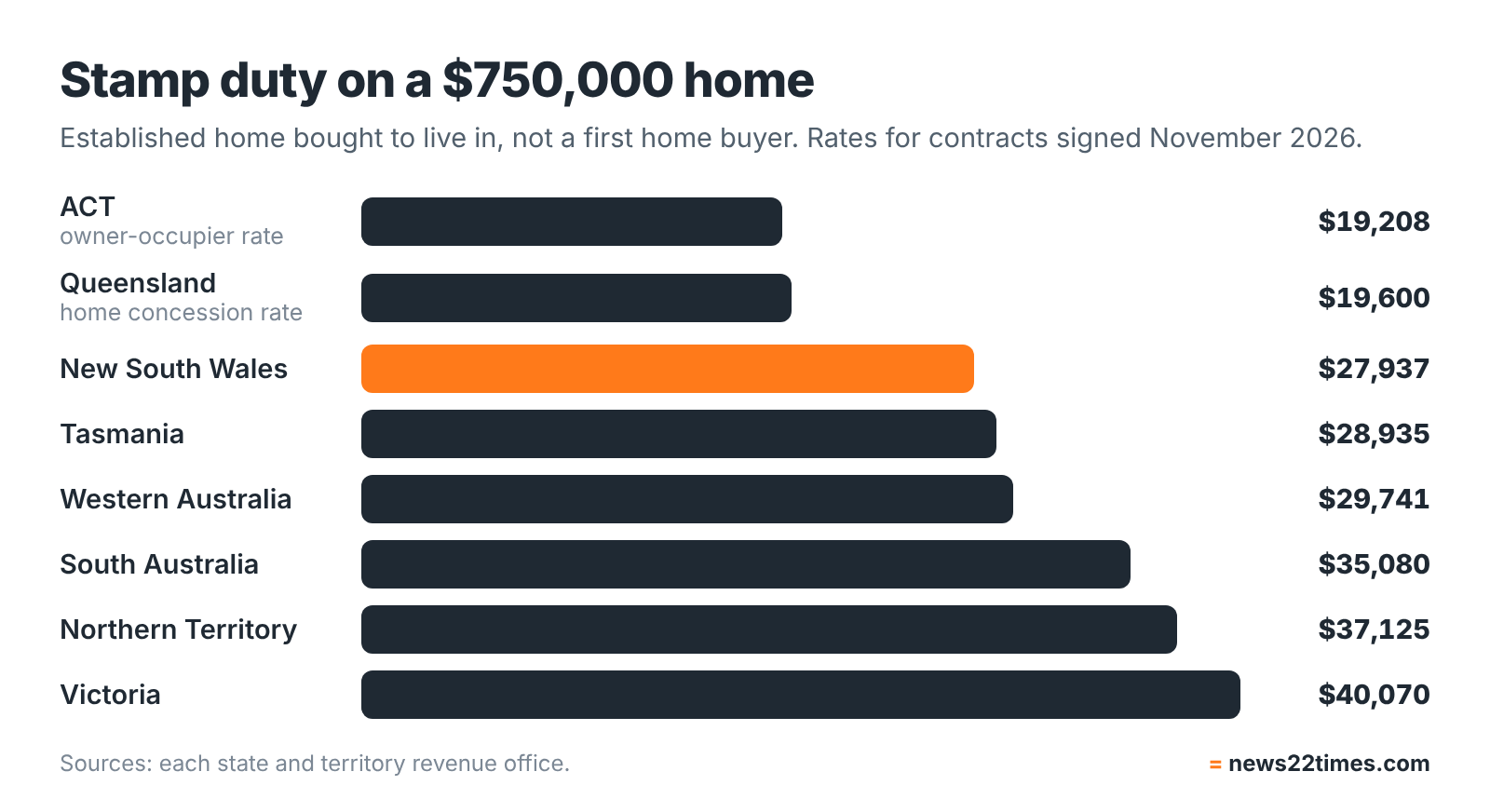
Victoria is the most expensive state for a $750,000 home because its general rate climbs to 6% from $130,000. The ACT and Queensland are cheapest for owner-occupiers thanks to their owner-occupier and home concession rates.
How stamp duty is calculated
Every state uses a sliding scale: the price is split into bands, and each band above a threshold is charged at a higher rate. Most states charge a set amount per $100 (or part of $100) above the start of your band, plus a fixed amount for the bands below.
Stamp duty = Fixed amount for your band + (Price − Band threshold) ÷ 100 × Rate per $100
Worked example: $750,000 in New South Wales
- Find the band: $750,000 falls in the $387,001 to $1,290,000 band.
- That band is $11,602 plus $4.50 for every $100 over $387,000.
- Amount over the threshold: $750,000 − $387,000 = $363,000, which is 3,630 lots of $100.
- 3,630 × $4.50 = $16,335.
- Stamp duty = $11,602 + $16,335 = $27,937.
The duty is based on the dutiable value: the price you pay or the property's market value, whichever is greater. If you buy from a relative at a discount, duty is still charged on the market value.
First home buyer stamp duty concessions by state
First home buyer schemes are where the biggest savings are, but every state draws its lines differently.
| State | No stamp duty up to | Reduced duty up to | Notes |
|---|---|---|---|
| NSW | $800,000 (land $350,000) | $1,000,000 (land $450,000) | New and established homes. |
| VIC | $600,000 | $750,000 | Sliding scale between $600,000 and $750,000. |
| QLD | $700,000 (land $350,000) | $800,000 (land $500,000) | New homes: no duty at any price. |
| WA | $600,000 (land $450,000) | $800,000 (land $550,000) | Thresholds raised from 7 May 2026. |
| SA | Any price | — | New homes and land to build only; no relief for established homes. |
| TAS | — | — | Established-home exemption ended 30 June 2026. |
| ACT | Any price | — | Home Buyer Concession from 1 July 2026; no income test. |
| NT | Any price | — | New house-and-land packages from a builder only (to 30 June 2027). |
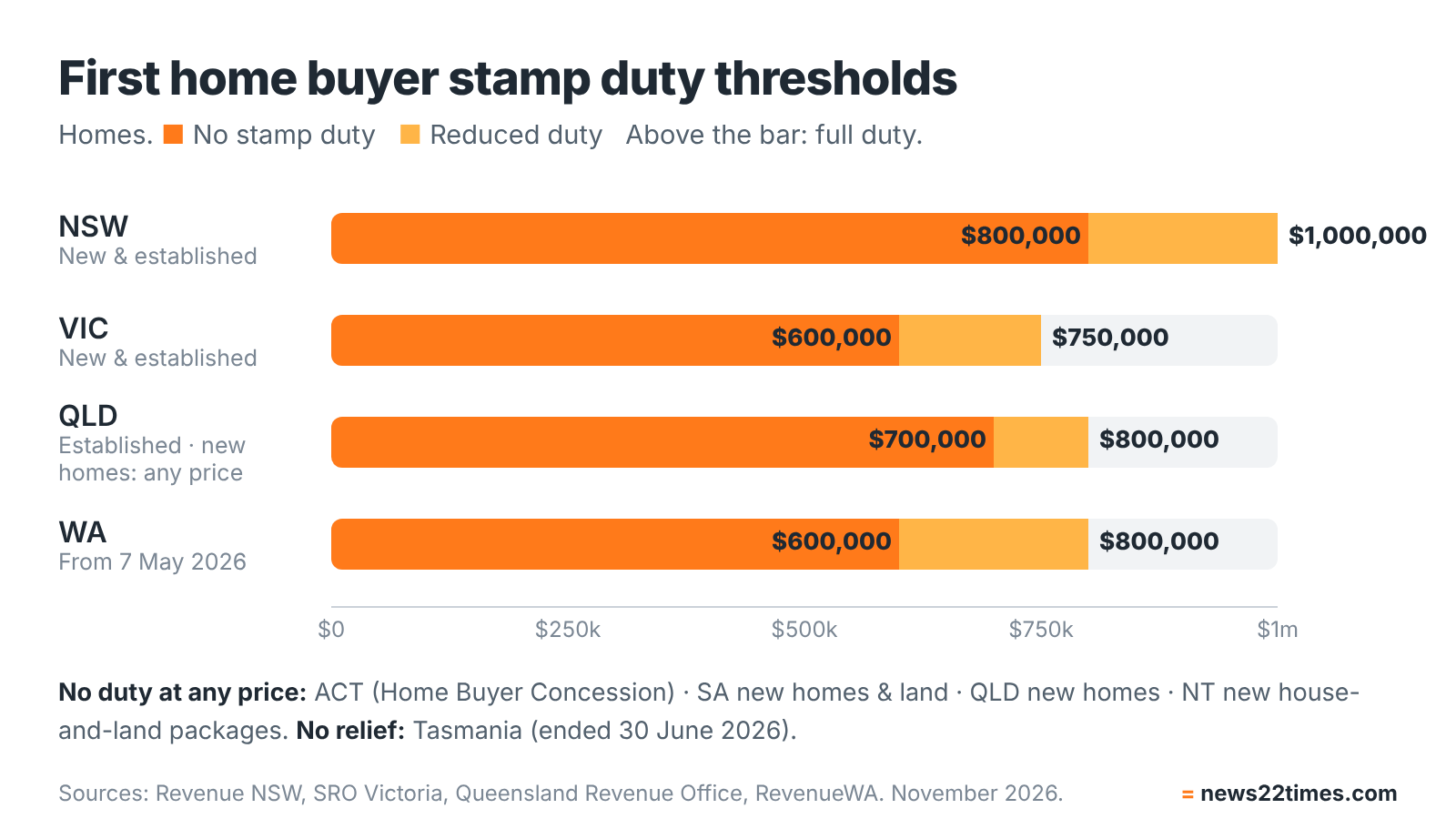
First home buyer schemes generally require that you (and your partner) have never owned residential property in Australia, are at least 18, are Australian citizens or permanent residents, and live in the home for a set period, usually 6 to 12 months starting within a year of settlement. The ACT's Home Buyer Concession Scheme is not limited to first home buyers; it uses its own prior property ownership test instead.
Stamp duty rates by state
New South Wales
Revenue NSW indexes its thresholds to inflation every 1 July. For 2026–27:
| Dutiable value | Duty |
|---|---|
| $0 – $18,000 | $1.25 per $100 (minimum $20) |
| $18,001 – $38,000 | $225 + $1.50 per $100 over $18,000 |
| $38,001 – $103,000 | $525 + $1.75 per $100 over $38,000 |
| $103,001 – $387,000 | $1,662 + $3.50 per $100 over $103,000 |
| $387,001 – $1,290,000 | $11,602 + $4.50 per $100 over $387,000 |
| Over $1,290,000 | $52,237 + $5.50 per $100 over $1,290,000 |
| Over $3,870,000 (premium) | $194,137 + $7.00 per $100 over $3,870,000 |
First home buyers pay no duty on homes up to $800,000 and reduced duty up to $1,000,000. Between those values the concession shrinks evenly: at $900,000 a first home buyer pays $19,594 instead of $34,687. Foreign buyers pay a 9% surcharge purchaser duty on residential property on top of transfer duty.
Victoria
| Dutiable value | General rate | Principal place of residence |
|---|---|---|
| $0 – $25,000 | 1.4% | 1.4% |
| $25,001 – $130,000 | $350 + 2.4% over $25,000 | $350 + 2.4% over $25,000 |
| $130,001 – $440,000 | $2,870 + 6% over $130,000 | $2,870 + 5% over $130,000 |
| $440,001 – $550,000 | $2,870 + 6% over $130,000 | $18,370 + 6% over $440,000 |
| $550,001 – $960,000 | $2,870 + 6% over $130,000 | General rate applies |
| $960,001 – $2,000,000 | 5.5% of the whole value | 5.5% of the whole value |
| Over $2,000,000 | $110,000 + 6.5% over $2,000,000 | $110,000 + 6.5% over $2,000,000 |
Owner-occupiers buying up to $550,000 get the principal place of residence concession. First home buyers pay nothing up to $600,000; between $600,000 and $750,000 the duty rises evenly from $0 to the full amount. Foreign purchasers pay an additional 8% duty. Victoria also has an off-the-plan concession for some apartments and townhouses.
Queensland
| Dutiable value | Transfer duty (general) | Home concession rate |
|---|---|---|
| Up to $5,000 | Nil | $1.00 per $100 |
| $5,001 – $75,000 | $1.50 per $100 over $5,000 | $1.00 per $100 |
| $75,001 – $350,000 | $1,050 + $3.50 per $100 over $75,000 | $1.00 per $100 |
| $350,001 – $540,000 | $1,050 + $3.50 per $100 over $75,000 | $3,500 + $3.50 per $100 over $350,000 |
| $540,001 – $1,000,000 | $17,325 + $4.50 per $100 over $540,000 | $10,150 + $4.50 per $100 over $540,000 |
| Over $1,000,000 | $38,025 + $5.75 per $100 over $1,000,000 | $30,850 + $5.75 per $100 over $1,000,000 |
If you will live in the home, the home concession rate applies. First home buyers of an established home deduct up to $17,350 from the home concession duty, which wipes out the duty to $700,000 and phases out in $10,000 steps by $800,000. Since 1 May 2025, first home buyers of a new home pay no transfer duty at any price. Foreign acquirers pay an extra 8% (AFAD).
Western Australia
| Dutiable value | General rate |
|---|---|
| $0 – $120,000 | $1.90 per $100 |
| $120,001 – $150,000 | $2,280 + $2.85 per $100 over $120,000 |
| $150,001 – $360,000 | $3,135 + $3.80 per $100 over $150,000 |
| $360,001 – $725,000 | $11,115 + $4.75 per $100 over $360,000 |
| Over $725,000 | $28,453 + $5.15 per $100 over $725,000 |
For transactions from 7 May 2026, first home owners pay no duty on homes up to $600,000 and $16.15 per $100 over $600,000 up to $800,000 (anywhere in WA). For vacant land it is nil to $450,000 and $20.14 per $100 over $450,000 up to $550,000. A concessional rate also applies to a principal place of residence worth up to $200,000. Foreign buyers pay 7% foreign transfer duty.
South Australia
South Australia's rates have not changed for many years: $1 per $100 to $12,000, rising through nine bands to $21,330 plus $5.50 per $100 over $500,000. Eligible first home buyers pay no stamp duty on a new home or vacant land to build a home, with no value cap. There is no relief for established homes. Foreign buyers pay a 7% foreign ownership surcharge.
Tasmania
Duty starts at $50 for properties up to $3,000 and rises to $27,810 plus $4.50 per $100 over $725,000. Tasmania's 100% first home buyer exemption for established homes up to $750,000 applied only to transfers that settled by 30 June 2026. Foreign buyers pay an 8% foreign investor duty surcharge on residential property.
Australian Capital Territory
The ACT is gradually replacing stamp duty with land rates, so its duty is lower than most states for owner-occupiers. Eligible owner-occupiers pay from $0.28 per $100 up to $260,000, rising to $33,958 plus $6.40 per $100 over $1,000,000. Investors pay more on lower-priced properties. Above $1,455,000 everyone pays a flat 4.54% of the whole value. From 1 July 2026 the Home Buyer Concession Scheme removed its price cap and income test, so eligible buyers who meet its prior property ownership rules pay no duty at all. The ACT does not charge a foreign buyer stamp duty surcharge.
Northern Territory
The NT uses a formula for properties under $525,000: duty = (0.06571441 × V²) + 15V, where V is the price divided by 1,000. From $525,000 it is a flat 4.95% of the whole value, 5.75% from $3 million and 5.95% from $5 million. A new house-and-land package bought from a builder is exempt under the House and Land Package Exemption for contracts signed up to 30 June 2027, with no value cap and no means test. The NT has no foreign buyer surcharge.
Foreign buyer stamp duty surcharges
| State | Surcharge on residential property |
|---|---|
| New South Wales | 9% surcharge purchaser duty |
| Victoria | 8% foreign purchaser additional duty |
| Queensland | 8% additional foreign acquirer duty |
| Tasmania | 8% foreign investor duty surcharge |
| Western Australia | 7% foreign transfer duty |
| South Australia | 7% foreign ownership surcharge |
| ACT and Northern Territory | No stamp duty surcharge |
The surcharge is charged on the share of the property the foreign person buys, on top of normal duty. Foreign buyers usually also need approval from the Foreign Investment Review Board and are generally not eligible for first home buyer concessions.
When is stamp duty paid?
Stamp duty is normally paid at or just before settlement, and your conveyancer or solicitor usually pays it for you through the electronic settlement platform. Deadlines are set by each state: in New South Wales, duty is due within three months of signing the contract; in Victoria, within 30 days of settlement. Late payment attracts interest and penalties.
Can you add stamp duty to your home loan?
Stamp duty is usually paid from your own savings, because lenders base the loan on the property price. Some buyers borrow more by increasing their loan-to-value ratio, but that can trigger lenders mortgage insurance and higher repayments. First home buyer exemptions and deferral schemes are usually a cheaper way to reduce the cash you need.
Other costs when you buy property
- Land titles transfer fee and mortgage registration fee charged by the state's land registry.
- Conveyancing or legal fees, plus searches and settlement fees.
- Building and pest inspections, and strata reports for apartments.
- Loan establishment fees and lenders mortgage insurance if your deposit is under 20%.
- Council and water rates adjustments at settlement.
Key facts
- Stamp duty is a state and territory tax, so rates differ across Australia.
- It is charged on the price or market value, whichever is higher.
- NSW first home buyers pay no duty up to $800,000 and reduced duty to $1 million.
- Victorian first home buyers pay no duty up to $600,000 and reduced duty to $750,000.
- Queensland first home buyers of a new home pay no transfer duty at any price.
- Foreign buyer surcharges range from 7% (WA, SA) to 9% (NSW).
Frequently asked questions
How is stamp duty calculated in Australia?
Each state uses a sliding scale. You pay a fixed amount for the bands below your price plus a rate per $100 for the amount above your band's threshold. For example, in NSW a $750,000 home is $11,602 plus $4.50 per $100 over $387,000, which is $27,937.
How much is stamp duty on a $500,000 house?
For an owner-occupier who is not a first home buyer: about $16,687 in NSW, $21,970 in Victoria, $8,750 in Queensland, $17,765 in WA, $21,330 in SA, $18,248 in Tasmania, $8,408 in the ACT and $23,929 in the NT.
Do first home buyers pay stamp duty?
Often not. NSW exempts homes up to $800,000, Victoria up to $600,000, Queensland established homes up to $700,000 and new homes at any price, WA up to $600,000, and the ACT at any price for eligible buyers. SA exempts new homes and land only.
Which state has the cheapest stamp duty?
For owner-occupiers on a typical home, the ACT and Queensland are usually cheapest because of their owner-occupier and home concession rates. Victoria is usually the most expensive.
When do I pay stamp duty?
Usually at settlement, paid by your conveyancer. NSW requires payment within three months of the contract date and Victoria within 30 days of settlement.
Is stamp duty charged on the price or the value?
On the dutiable value, which is the price paid or the market value, whichever is higher.
Do foreign buyers pay more stamp duty?
Yes, in six states: 9% extra in NSW, 8% in Victoria, Queensland and Tasmania, and 7% in WA and SA. The ACT and NT have no stamp duty surcharge.
Can I pay stamp duty in instalments?
Some schemes allow it. NSW's First Home Buyer Choice ended in 2023, and the ACT allows eligible buyers to defer duty. Check your state's revenue office.
Is stamp duty tax deductible?
Not for your home. For an investment property it is not deductible in the year you pay it, but it forms part of the cost base for capital gains tax when you sell.
Sources & methodology
- Revenue NSW — How to calculate transfer duty
- Revenue NSW — First Home Buyers Assistance Scheme
- State Revenue Office Victoria — Land transfer duty current rates
- State Revenue Office Victoria — First home buyer duty exemption or concession
- Queensland Revenue Office — Transfer duty rates
- Queensland Revenue Office — Home concession rates
- RevenueWA — Transfer duty assessment
- RevenueSA — Rate of stamp duty
- State Revenue Office Tasmania — Rates of duty
- ACT Revenue Office — Conveyance duty for non-commercial property
- NT Government — House and Land Package Exemption
- N22 calculation methodology
Read our full calculation methodology.
News22Times (2026). Stamp Duty Calculator Australia: All States & First Home Buyers. Retrieved from https://www.news22times.com/stamp-duty-calculator-australia/Results are estimates for general information only and are not financial, tax or legal advice. Always confirm with an official source or a qualified professional. See our disclaimer.